What is AI better at than humans? Speed.
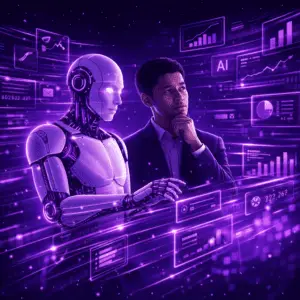
Speed is the most visible superpower of artificial intelligence. It analyzes enormous data sets, raises alerts and finds correlations in seconds. Financial anomalies, supply chain disruptions, shifts in customer behavior, operational waste: all detected almost instantly. For organizations that used to wait weeks or months for that kind of insight, this is a dramatic change.
Machines are built for computation. They process signals, remember vast quantities of data and apply statistical models without getting tired. They do not forget a transaction, and they do not overlook the small irregularity hidden in millions of data points.
Speed also creates a quieter leadership problem. When information arrives instantly, people start expecting decisions to arrive just as fast. Dashboards refresh constantly, alerts demand a reaction, and executives feel pressure to respond to signals instead of thinking about them. Speed is addictive. It is not the same as understanding.
AI can tell you that something unusual happened. A human has to decide whether it matters. The organizations that get this right use machines to accelerate insight and deliberately protect the time human judgment needs. Without that balance, speed starts to drown out meaning. I wrote more about that trap in why the speed of AI is not always intelligent.
How does human intelligence read the story behind the data?
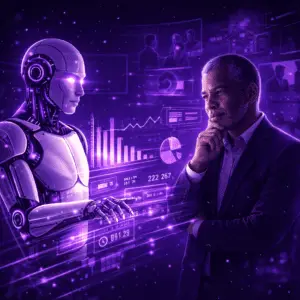
If AI is excellent at detecting patterns, humans are excellent at interpreting them. Data rarely tells the whole story. An algorithm can flag falling engagement, odd purchasing behavior or an unexpected production delay. The numbers rarely say why.
Humans bring context. A leader remembers the conversation that never made it into a report. The tension in a meeting that hinted at a bigger problem. The small issue that is about to become a cultural risk.
A data set might show that productivity dropped in one quarter. A leader remembers that this was the quarter of the restructuring, the new management team and a nervous market. Numbers identify patterns. People interpret causes. Without that interpretation, even the most sophisticated analytics stay incomplete.
Why does experience teach what data cannot?
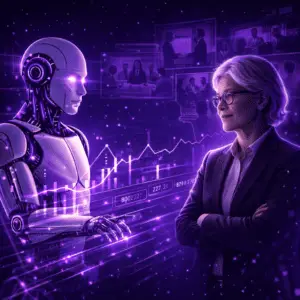
The two kinds of intelligence also learn differently. AI learns from data: more examples, more signals, more outcomes, better models.
Humans learn from experience. A leader who has been through a crisis understands dynamics no spreadsheet can show. Someone who has led a team through failure remembers how it felt and what it taught them. Experience shapes judgment.
Failure is part of that. Organizations like to treat it as something to avoid, yet human intelligence grows precisely because people reflect on their mistakes. We remember how a poor decision affected colleagues, customers or a reputation. AI records outcomes. Humans remember consequences.
Reflection closes the loop. We can stop and ask what happened, why it happened and what should change next time. That is how wisdom forms, and wisdom is a lot more complicated than data.
Artificial intelligence records outcomes. Humans remember consequences.
Can AI be creative, or does creativity start where data ends?
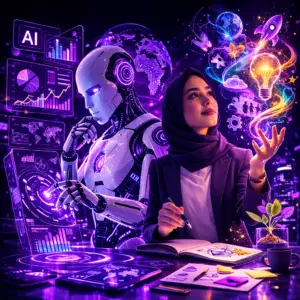
AI can produce variations of existing ideas. It recombines patterns from its training data and creates outputs that look creative. True creativity usually asks for something else: imagining what has never existed.
Innovation often comes from an unexpected question rather than an optimized answer. Leaders who challenge assumptions, try odd ideas or bet on unconventional strategies tend to produce the breakthroughs. Machines rarely make those leaps on their own.
A data set suggests a five percent improvement. Human imagination asks whether the whole system should be redesigned. Think of the ideas that actually changed organizations: customer experiences rebuilt around empathy, cultures rebuilt around trust, entire industries reshaped by someone who refused to think like everyone else. Those moments rarely start in an algorithm. They start in human curiosity. AI analyzes the past with extraordinary precision. Humans imagine what lies beyond it.
Who carries ethics, intuition and responsibility?
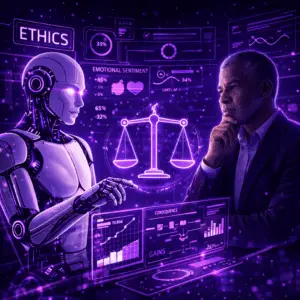
This may be the most important difference of all. AI can detect emotional language in a customer message, analyze tone in a conversation and map sentiment. Recognizing an emotion is not the same as feeling it.
Humans feel responsibility. Leaders have to weigh consequences that go beyond efficiency, because decisions affect people, communities and reputations. Ethical judgment needs empathy, perspective and moral reasoning, and none of that can be fully automated.
Intuition matters too. Experienced leaders sometimes sense that something is off while every dashboard looks fine. They pick up small signals in a conversation or a hallway that point to a deeper problem. Those instincts come from years of experience and reflection. AI processes signals. Humans sense the meaning inside them. Organizations that forget this end up delegating decisions that need a human to own them. More on that in AI decisions vs human choices.
Artificial intelligence vs human intelligence: why leadership is not a competition
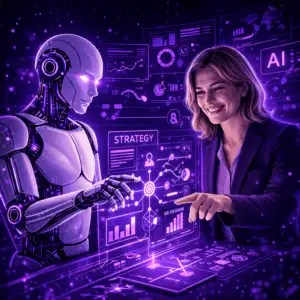
The most useful way to see the two is as collaborators. AI amplifies human performance: faster analysis, better pattern recognition and predictions that show risks and opportunities earlier. Human intelligence makes sure those insights turn into wise decisions.
Leaders ask the questions algorithms cannot answer. What truly matters right now? What will this decision do to people? Which long-term values should guide this choice? Those questions are what turn information into strategy.
So the future of leadership will not be decided by competing with machines on speed or data processing. Nobody wins that race. It will be decided by how well leaders combine machine intelligence with human judgment.
Why do humans still carry the final responsibility?
AI will keep advancing fast. It will analyze faster, generate insight sooner and automate more complex work. One thing will not change: organizations are still led by humans.
So the conversation should not be about replacement. It should be about responsibility. Machines generate recommendations. Humans decide what they mean. Machines process data. Humans decide what is significant. Machines accelerate decisions. Humans stay accountable for what happens next.
The strongest organizations will not be the ones that rely only on AI. They will be the ones that remember why human intelligence still matters.
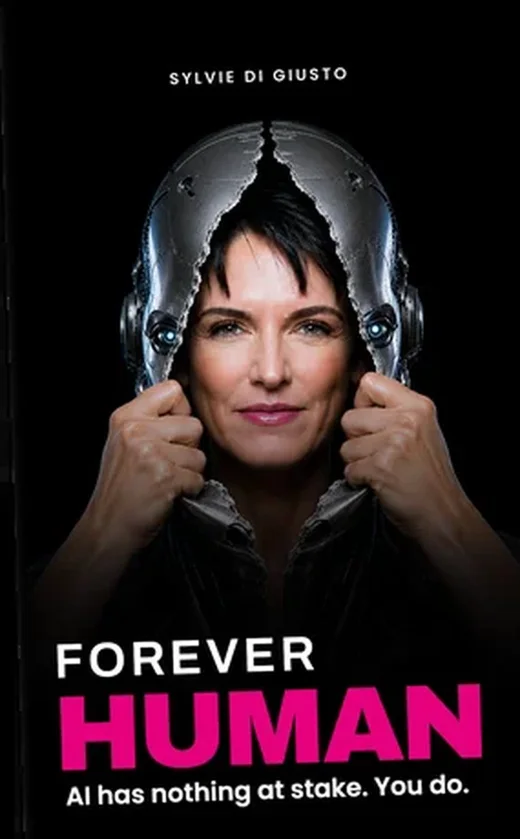
Forever Human
Speed, meaning, experience, imagination, responsibility: everything in this article is a piece of the bigger question I answer in my book Forever Human. Which human moves stay valuable when machines can do almost everything else, and how do leaders make them on purpose?