
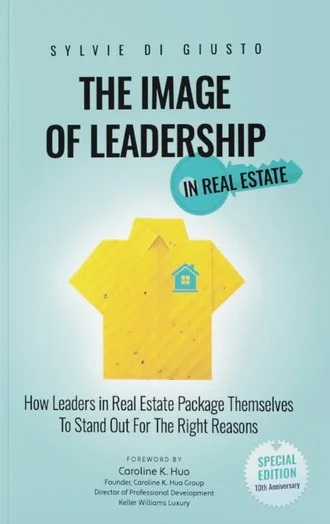
The Image of Leadership in Real Estate cover
The Blueprint of Influence

The Image of Leadership in Real Estate

Clients choose an agent before they choose a home.
Special edition · foreword by Caroline K. Huo

Order on Amazon

You are the first property they evaluate.

This edition is written for the people who sell, lease, manage and develop property, where clients hand you their most significant financial decision and judge you long before they review your track record. It shows real estate leaders how to build a professional identity that wins the listing, earns the referral and sets the standard for an entire team or brokerage, in person and online.

I was overwhelmed with gratitude when I realized that what I had wished I had known twenty years ago is now in the pages of this one magical book.
Caroline K. HuoFounder, Caroline K. Huo Group; Director of Professional Development, Keller Williams Luxury, foreword to this edition

Who this edition is for

  • A newer agent working toward a first deal who wants to be taken seriously from the first meeting
  • A luxury listing agent competing against equally qualified peers for high-end properties
  • A team leader responsible for the standards and reputation of a group of agents
  • A brokerage executive steering a firm and representing its brand at every touchpoint
  • A commercial property manager or investment professional moving between corporate offices, tenants and job sites
  • A founder of an independent agency, or a leader in industrial real estate or land development, building a name from the ground up

The five signals, for Real Estate

AAppearanceWhat people see first, and keep seeing.
BBehaviorHow you act in the room, and when no one is watching.
CCommunicationThe verbal and nonverbal messages you send.
DDigitalWho you are online before anyone meets you.
EEnvironmentThe spaces and people you surround yourself with.
The opening story

Sarah, Emily and the Condo Listing

Two real estate professionals, Sarah and Emily, are competing to become the listing agent for a high-end condo owned by a couple, Mark and Lisa. It is a major opportunity for both careers, and on paper the two are identical: the same qualifications, the same track record, the same invitation. Each waits in the sleek lobby of the upscale building, each is greeted by Lisa with a firm handshake, and each walks past the concierge desk and the residents’ lounge to the same living room. Yet Sarah’s meeting ends after twenty minutes with a polite promise to be in touch, while Emily’s runs an hour and closes with an invitation to continue next week. That evening, Lisa and Mark discuss the two candidates and reach a clear verdict on each. If their credentials were equal, what did the couple see that decided the listing before either agent said a word?

Chapter 1 tells you what happened next.

Inside the book

  1. Seven SecondsWhy clients, buyers and developers decide in moments whether to trust you with their property, told through the Sarah and Emily listing story and a walk through a real estate office seen with a client’s eyes.
  2. Your Professional IdentityHow the professional identity of agents and leaders shapes the reputation of the brokerage, agency or property management firm behind them, and why a picture-perfect identity that stays invisible to upper management serves no one.
  3. Leaders Look ConfidentConfidence as the foundation beneath the skyscraper: the comparison trap of leaderboards and commission figures, the constant companion of rejection, and being confident about your body, age, gender identity and style.
  4. Leaders Look AuthenticThe chameleon or the peacock: how real estate leaders balance blending in with standing out, why “You do you” is misleading advice, and seven keyword styles that anchor an authentic identity.
  5. Leaders Look ProfessionalWhat professional means today across residential, commercial and land sectors, from the uniforms of leasing agents and model home representatives to the unwritten dress codes of investment firms, proptech startups and luxury sales.
  6. Leaders Look RespectfulSelf-respect as the CEO of your own real estate career, the respect your presence shows clients, team and brokerage, and how to recover when something goes wrong, even during a listing presentation.
  7. Leaders Look ControlledSteering your professional identity like a ship’s captain: self-awareness, self-care and self-promotion, preparing your look for the day’s showings and meetings, and how your car and office speak for you.
  8. Leadership in a Digital LandscapeYour brokerage bio, LinkedIn profile, webcam and client reviews as the new handshake, and how real estate leaders know, repair, own, control and monitor the online presence clients check before they call.
  9. Leaders Lead by ExampleHow your choices set the organic dress code for your agents, the excuses team members offer, and how to hold sensitive conversations about appearance, conduct or social media without damaging trust.
  10. Moving ForwardBringing it together for the real estate leader who wants to stand out for the right reasons, and the meaning of the potato chip on the cover for anyone whose packaging promises what’s inside.

Only in this edition

The Filters Clients Bring to Every Showing

Clients arrive at one of the biggest financial decisions of their lives carrying confirmation bias, anchoring bias and the horn effect, whether they know it or not. A disorganized car before a property viewing, a hesitant answer about recent market developments or a typo in your materials can become the anchor that colors everything that follows. Drawing even on a story from her own marriage, Sylvie shows how these mental shortcuts shape what clients and team members notice, and how a real estate leader can turn the same biases into an advantage.

Respected First, Liked Second

In a leadership seminar for real estate leaders, the trainers were horses. The group that offered treats and affection never earned the horse’s attention. The confident group did, until their conduct turned inconsistent and the horse stopped following. Sylvie draws a clear lesson for brokerage leaders: being respected is the goal, being liked is a bonus, and predictability and consistency are what sustain trust long after the first meeting. It is leadership through influence, not force, applied to clients and teams alike.

Good Is the Baseline in Real Estate

Excellence is the new norm across the industry, and “good” no longer sets anyone apart. Sylvie uses Tetris to make the point: the piece that fits perfectly completes a line, then disappears. Real estate leaders who align too perfectly with the patterns already in play become part of the background. The book explains why standing out for its own sake is a terrible idea in real estate, and outlines the three choices that set leaders apart for the right reasons, illustrated by an office that reimagines every step of the client experience.

One Brokerage, One Message

Your appearance, behavior, communication, digital footprint and environment must all sing the same tune, inside your brokerage and in the wider market. Sylvie contrasts the internal identity you show your team and upper management with the external one on display at listing presentations, networking events and industry conferences. Then she raises the harder test: a team member who undermines your conference presentation from the audience, or a picture-perfect agent whose social media tells a different story. Consistency is a team standard, not a personal one.

The CEO of Your Real Estate Career

In an industry where success is constantly measured and celebrated, imposter syndrome can be especially loud, and promoting your own wins can feel like bragging. Sylvie asks a simple question: if you don’t advocate for your achievements, who will? She reframes self-promotion as controlling your narrative and advocating for the value you bring to your brokerage, positions every reader as the CEO of their own real estate career, and makes the case for progress over perfection in a field where the goalposts keep moving.

The Conversations Brokerage Leaders Avoid

Unfortunate social media posts, mismanaged emotions, neglected workspaces, a lack of respect toward clients: sooner or later a real estate leader has to address them with a team member. Many hesitate, wanting to protect harmony or stay nonconfrontational. Sylvie shows how to approach these moments with confidence and clarity: prepare precisely, consult HR or legal counsel when needed, choose a private room away from the bustle of the office and a calm moment outside peak hours, and open with specific praise tied to real transaction outcomes.

Questions readers ask

Why do sellers choose one listing agent over another with the same track record?

Before clients hire you, they need to buy into you: can they trust you, and do you understand their needs? The book follows two agents with identical track records competing for a luxury condo listing. One is shown the door after twenty minutes; the other is invited back. Sellers rarely say why, but subtle cues of presence and readiness weighed heavily. Chapter 1, Seven Seconds, covers this in depth.

Why am I not getting ahead in real estate when I do good work?

Good work alone rarely gets your name mentioned when opportunities arise. The book describes four visibility levels: invisible, common, unique and referable. At the common level you are dependable but interchangeable. Sylvie shares how she stayed stuck there for years in her corporate career, and how she moved up by deliberately working on every part of her professional identity. Chapter 2, Your Professional Identity, covers this in depth.

Should a real estate agent's look change with the market, property or client?

Yes, through what the book calls situational awareness. In its listing story, a look that might have worked elsewhere failed to match a high-end property's image. Practical demands matter too: a conference stage, a construction site visit or a market crisis may call for a different approach. Because a potential client could appear anywhere, even on a plane, your presence is never off duty. Chapter 5, Leaders Look Professional, covers this in depth.

How should a real estate agent recover after a mistake with a client?

Mistakes range from a phone ringing during a listing presentation to a comment that lands badly. The book warns against two pitfalls: ignoring the problem and offering a hollow sorry. Instead, assess the impact, choose the right timing, apologize privately and in person where possible, take responsibility without excuses, share what you have learned, listen, and give trust time to rebuild. Chapter 6, Leaders Look Respectful, covers this in depth.

How do I address a sensitive issue with an agent on my team?

The issue may be attire, hygiene, emotions, a social media post or how clients are treated, and many leaders avoid these talks to protect harmony. The book reframes them as support for the agent's professional development. It covers preparing, consulting HR or legal advisors, choosing a private setting, using neutral and specific language, describing consequences, handling pushback and following up. Chapter 9, Leaders Lead by Example, covers this in depth.

How do online reviews and search results affect a real estate agent?

Clients often meet you online first, through your brokerage bio, LinkedIn profile, profile photo or a virtual tour. Search engines act as the new background check, and your place on Google's first page shapes perceived credibility. The book's five steps (know, repair, own, control and monitor) include tracking client reviews, thanking people for positive ones and answering negative ones constructively. Chapter 8, Leadership in a Digital Landscape, covers this in depth.

Does the car I drive or my office affect how clients see me?

It can. The book notes that a poorly maintained car may suggest a disregard for efficiency, while a luxury sports car may prompt clients to question your financial judgment. An organized, functional office signals attention to detail to visiting clients. You are also judged by the company you keep, so surround yourself with people who reinforce the professional identity you want to be known for. Chapter 7, Leaders Look Controlled, covers this in depth.

Can I order copies for my team or conference?

Yes. Preferred pricing is available for groups, conferences and client gifts, and signed copies are available on request. Many organizations pair the book with The Power of Choice keynote, which is built on it.

Is this edition available as an ebook?

Yes. The Image of Leadership in Real Estate is available in paperback and as a Kindle ebook on Amazon.

Around the clock

Still have questions? Ask Edna.

Edna

Ready to make your people impossible to replace?