
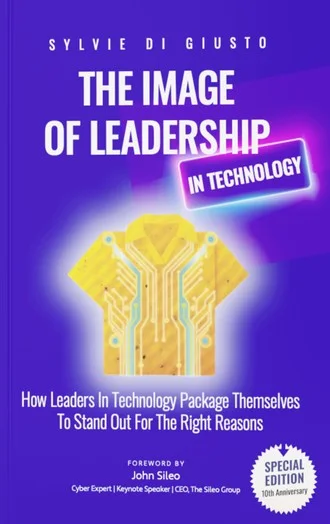
The Image of Leadership in Technology cover
The Code of Influence

The Image of Leadership in Technology

Technical brilliance gets you into the room. How you are perceived decides whether you lead it.
Special edition · foreword by John Sileo

Order on Amazon

Great code doesn’t speak for itself. You do.

The Image of Leadership in Technology shows tech leaders, from the team lead in a start-up to the CTO of a Fortune 500 organization, how team members, senior management and investors decide within seconds whether to buy into you as a leader. It translates Sylvie di Giusto’s professional identity framework into the realities of the tech sector: the unwritten uniforms of start-ups, fintech and AI firms, the webcam as your new handshake, and the paradox of leaders who build cutting-edge solutions yet neglect their own digital presence.

We straddle two worlds: the technical domain where we earned our credentials and the leadership sphere where the priority is getting things done. That’s where The Image of Leadership in Technology is a crash course in translation.
John SileoCyber Expert, Keynote Speaker, CEO of The Sileo Group, foreword to this edition

Who this edition is for

  • A tenacious team leader making first strategic decisions in a start-up
  • A developer just promoted to lead a software development team
  • A mid-level professional eyeing a leap into senior management of a cybersecurity firm
  • A leader guiding an AI research project or a cloud computing division
  • A founder pitching a start-up vision to investors and partners
  • A seasoned CTO or CIO aiming for a top executive position in a Fortune 500 tech organization

The five signals, for Technology

AAppearanceWhat people see first, and keep seeing.
BBehaviorHow you act in the room, and when no one is watching.
CCommunicationThe verbal and nonverbal messages you send.
DDigitalWho you are online before anyone meets you.
EEnvironmentThe spaces and people you surround yourself with.
The opening story

Tim, Brian and Kelly

Two technology professionals, Tim and Brian, are competing for the role of director of information technology at a prestigious Fortune 500 organization. On paper they are identical: same qualifications, same résumé full of successful tech projects. Both are greeted by Kelly, the chief operating officer, in the sleek lobby of the main building. Both walk with her past clusters of developers and real-time dashboards to her glass-walled office. Yet the two interviews could not unfold more differently. Tim feels the opportunity slipping away like data through a leaky firewall and is shown the door after twenty minutes. Brian is offered a coffee, drawn into a conversation about the organization’s new blockchain initiative, introduced to the senior manager of the blockchain division, and invited back for a tour of the innovation lab. At the executive leadership meeting the next day, Kelly’s verdict on one candidate is a decisive no. On the other: “Very impressive.” So what did Kelly see in the lobby that neither résumé could tell her?

Chapter 1 tells you what happened next.

Inside the book

  1. Seven SecondsThrough the story of Tim and Brian, this chapter shows how quickly colleagues and investors decide whether to follow you, what a poor professional identity costs, and why one incongruent detail, from a sticker-covered laptop to typos in a slide deck, can overshadow your expertise.
  2. Your Professional IdentityWhy tech leaders shape how their organization’s ability to deliver innovation is perceived. Introduces the ABCDEs (appearance, behavior, communication, digital footprint, environment), internal and external consistency at tech conferences and online, and four visibility levels from invisible to referable.
  3. Leaders Look ConfidentThe enemies of confidence in a sector where change is exponential, from constant rejection to imposter syndrome, and how confidence about your body, age, gender identity and style plays out from the start-up’s open office to the Fortune 500 boardroom.
  4. Leaders Look AuthenticChameleon or peacock? Why “You do you” is risky advice, and how seven keyword styles help you build a signature look that fits settings as different as gaming, consumer tech, creative agencies, research labs and cybersecurity.
  5. Leaders Look ProfessionalFrom boardroom attire to baseline casual, and the unwritten uniforms of tech: conservative suits in financial technology, T-shirts and jeans in start-ups, eclectic looks in UX design and “smart-tech chic” in premium software and AI organizations.
  6. Leaders Look RespectfulHow your look signals respect for yourself, your team, your stakeholders and your organization, why that respect is not always returned, and how to rebuild trust after a misstep, from a ringing phone during a product demo to mishandled sensitive data.
  7. Leaders Look ControlledSelf-awareness, self-care and self-promotion as a cycle of control, with planning questions for days that may hold a product launch, a coding sprint or a board meeting, and why your devices and workspace must match your look.
  8. Leadership in a Digital LandscapeThe paradox of the tech leader who builds cutting-edge solutions yet neglects their own digital presence. Five steps (know, repair, own, control, monitor) cover search results, profiles, virtual meeting setups and the permanence of every click.
  9. Leaders Lead by ExampleHow your example becomes your team’s unspoken dress code, the excuses leaders hear (including “We’re in New Jersey, not Silicon Valley”), and how to prepare sensitive conversations about attire, hygiene or social media posts with team members.
  10. Moving ForwardThe potato chip on the cover explained: what the snack aisle teaches tech leaders about promise, expectation and shelf space, and why your packaging should amplify your strengths rather than overshadow them.

Only in this edition

The Invisible Filters in Your Tech Team

Before you open the discussion on a new AI project, your team member is already reading you. A cluttered desk, a demo that stalls, a typo in your technical documentation or a slight hesitation on a question about system integration can trigger the horn effect. Anchoring bias then holds on to that moment, and confirmation bias collects every detail that fits it. Sylvie unpacks the unconscious biases that silently shape how tech leaders are judged, and shows how the same filters can be turned to work in your favor.

Beyond the Launch: The Sustained Imprint

In a leadership seminar Sylvie organized in Europe, the trainers were horses. One group won instant compliance through confident, decisive conduct; the other offered treats and affection and got little in return. Yet the first group’s success faded the moment their behavior became unpredictable. The lesson for tech leaders is unmistakable: being liked is a bonus, being respected is the foundation, and predictability and consistency are what earn trust and respect. Your imprint is not set at the kickoff; it is maintained sprint after sprint, release after release.

Don’t Be the Completed Line

In Tetris, the piece that fits perfectly completes a line and disappears. That is a triumph in the game and a warning in your tech career. In a field that values innovation and cutting-edge thinking, “good” is merely the baseline, and average blends in until it becomes invisible. Sylvie explains why standing out for its own sake is a terrible idea, and why the leader worth remembering is the piece that starts a reaction, like the one who introduces a groundbreaking approach to agile development or pioneers a new way of integrating AI.

One Message, From Stand-Up to Conference Stage

Your appearance, behavior, communication, digital footprint and environment must all sing the same tune, inside your organization and out. Internally, that means your department, cross-functional teams and senior management. Externally, it means clients, tech conferences, networking events and the broader market. And consistency cannot stop with you. A team member who speaks loudly during your conference presentation, or whose social media contradicts an impeccable in-person presence, speaks for your organization too. Sylvie shows how to build one coherent, credible message across the entire team, in a field where public perception is crucial.

Your Work Will Not Speak for Itself

Many tech leaders assume their work will speak for itself, in an industry that often values collaborative effort over individual credit. The book asks a sharper question: if you don’t advocate for your achievements, who will? Effective self-promotion is not bragging; it is controlling your narrative as the CEO of your own career. Sylvie addresses the fear of backlash, the pull of imposter syndrome and the exhausting chase for flawlessness, and makes the case for progress over perfection, where mistakes are a natural part of learning and innovation.

The Conversations Tech Leaders Avoid

Some of the hardest moments in leadership happen behind a closed door: an unfortunate social media post about an organization initiative, emotions that boil over during a high-stress project, constant tardiness to scrum meetings. Sylvie explains why leaders avoid these conversations and how to hold them well. Prepare with precision, get guidance from HR or a legal advisor when needed, choose a private space away from the open office and a moment outside peak hours, open with specific praise, and keep the focus on professional growth rather than personal criticism.

Questions readers ask

Why do qualified tech professionals get passed over for leadership roles?

Because credentials only earn you the interview. The book follows Tim and Brian, two candidates with identical résumés competing for a director of information technology role. Before either could discuss strategy, the COO had already decided who seemed ready to lead, and no one would ever cite that reason out loud. Before people follow you, they first need to buy into you. Chapter 1, Seven Seconds, shows what tipped the decision.

How do I get promoted to a senior leadership role in tech?

Doing good work is rarely enough. Sylvie describes four visibility levels: invisible, common, unique and referable. Many hardworking tech leaders stall at common, dependable yet interchangeable, and wonder why they are not getting ahead. Promotions go to leaders who are referable, discussed in high-level meetings and recommended without their involvement. Getting there takes intentional work on every element of your professional identity. Chapter 2, Your Professional Identity, maps the path.

Does what you wear still matter in a casual tech culture?

Yes, because every corner of tech has an unwritten uniform: conservative suits in fintech, T-shirts and jeans in start-ups, eclectic looks in UX design and "smart-tech chic" in premium software and AI. Decode yours by observing the leaders around you, the context of each interaction and the expectations tied to your role, then bend the standard subtly with a personal touch. Chapter 5, Leaders Look Professional, explores these silent standards.

How can a tech leader rebuild trust after a mistake?

Avoid the two common pitfalls: ignoring the problem and offering a hollow apology. Whether it is a phone ringing during a product demo or a lapse in handling sensitive data, assess the impact, choose your timing and apologize privately, in person whenever possible. Own the mistake without excuses, share what you have learned, listen more than you speak, and give trust time to return. Chapter 6, Leaders Look Respectful, covers damage control.

How do I have a difficult conversation with a team member about performance or conduct?

Prepare first: define the issue precisely, its consequences for the team, and whether HR or a legal advisor should be involved. Hold the conversation in private, never in the open office or just before a stressful meeting. Open with specific praise, use neutral language and spell out the change you expect, such as exact dates for code submissions. Then summarize, document and follow up. Chapter 9, Leaders Lead by Example, walks you through it.

How should tech leaders manage their LinkedIn profile and online presence?

Ironically, many tech leaders who build cutting-edge solutions neglect their own digital presence, even though search engines act as the new background check. An outdated profile or broken links to past projects suggest you are disconnected from current trends. Sylvie's five steps begin with knowing what is out there, through a private-browsing search of your name, then repairing, owning, controlling and monitoring it. Chapter 8, Leadership in a Digital Landscape, covers this in depth.

What do a tech leader's devices and workspace say about them?

The devices you choose are not merely tools but a reflection of you; an outdated laptop can signal a disregard for modern efficiency. The layout and condition of your office, even the books on your shelves, color how your team perceives you. And because you are judged by the company you keep, the people you associate with reflect on you, too. Chapter 7, Leaders Look Controlled, explains why your environment must match your look.

Can I order copies for my team or conference?

Yes. Preferred pricing is available for groups, conferences and client gifts, and signed copies are available on request. Many organizations pair the book with The Power of Choice keynote, which is built on it.

Is this edition available as an ebook?

Yes. The Image of Leadership in Technology is available in paperback and as a Kindle ebook on Amazon.

Around the clock

Still have questions? Ask Edna.

Edna

Ready to make your people impossible to replace?