The five elements of emotional intelligence people see first
The five elements of emotional intelligence that decide how you are perceived at work are visual intelligence (appearance), behavioral intelligence (behavior), communicational intelligence (communication), digital intelligence (your digital footprint) and social intelligence (your environment). Together they form your ABCDE, and decision-makers read all five.
At work, the way you present yourself influences decision-makers, customers, stakeholders and more. They are heavily influenced by their own unconscious biases, and the way you interact with them can change the outcome.
These five elements help any professional stand out from the crowd, because they make you aware of how your appearance, behavior, communication, digital presence and surroundings affect the people around you. Awareness first. Then choice.
KEY TAKEAWAYS
- Humans are visual: people assume your success, capability and education from how you look. Unfair, yes. Realistic, absolutely.
- Your behavior, including tiny micro behaviors, tells people how much you respect them.
- Communication is verbal, nonverbal, written and visual, and its meaning changes with context.
- Your digital footprint is intentional and unintentional, and both shape how you are judged before anyone meets you.
- Your environment, from your network to your commute, becomes part of how others see you.
- The five only work together. You cannot look one way and act another.
011. Visual intelligence: what does your appearance say?
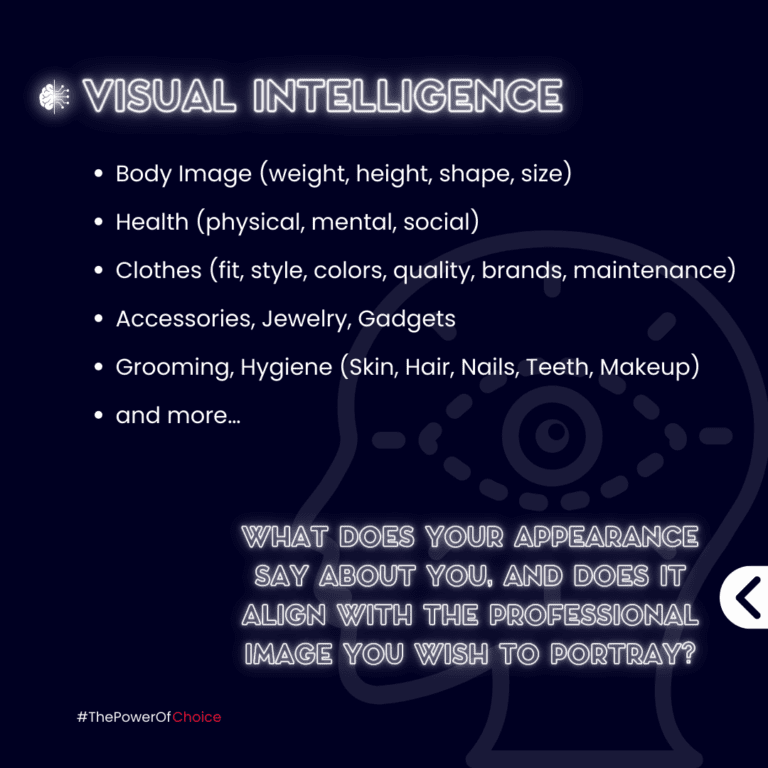
Visual intelligence is about how you present yourself through the clothes you wear, your makeup or hairstyle, your accessories and your overall look. It shapes how customers judge your professionalism and how decision-makers see your presence at work.
It refers only to your outward appearance: everything that you and others can see. And that has a strong effect on the value you place on yourself and the value others place on you.
You may believe your appearance should not matter and that you are much more than your look. Quite rightly. Each of us is far more than the sum of our appearance. But humans are visual creatures. In the blink of an eye, they assess how you look and assume the characteristics they think your appearance conveys. So even if you wish it did not, your look affects how people perceive you. Aspects of your appearance include:
- body image (weight, height, shape, size)
- health (physical, mental, social)
- clothes (fit, style, colors, quality, brands, maintenance)
- accessories, jewelry, gadgets
- grooming and hygiene (skin, hair, nails, teeth, makeup)
- and more
Decision-makers often form a subconscious assumption about your success, capabilities, education and professional reputation based on your appearance. Unfair? Yes. Realistic? Absolutely. So ask yourself: what does your appearance say about you, and does it match the professional image you want to project?
022. Behavioral intelligence: what does your behavior say?
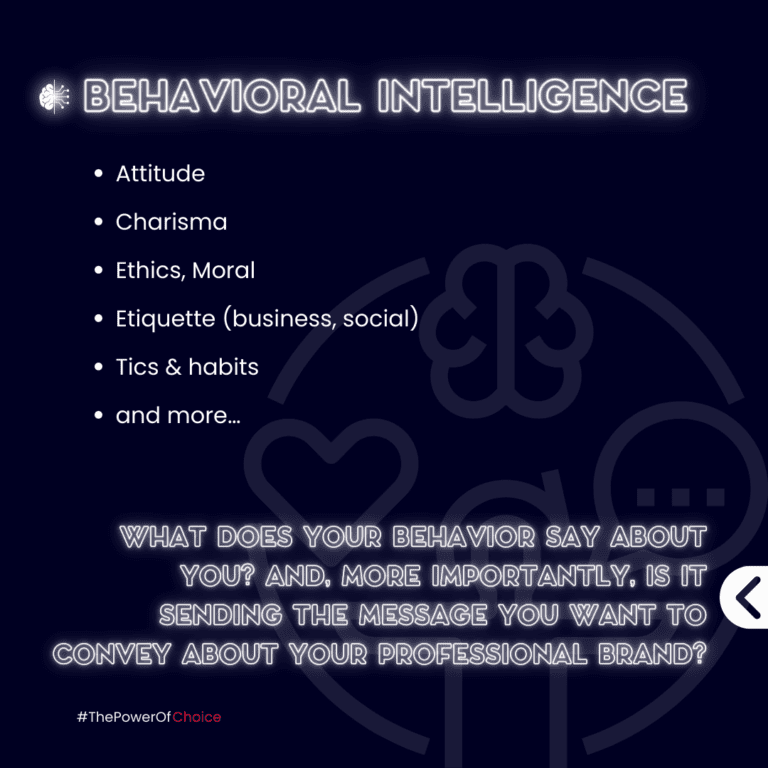
Behavioral intelligence is about how you interact with the people around you and how you behave with colleagues, managers and customers. It shows how much respect you give others and what kind of connection forms as a result.
It covers your mental, physical and social responses to whatever happens around you or inside you, in a specific situation or under specific circumstances. Some actions and their effects are obvious. Others, the subtle micro behaviors, are much harder to spot and control. Yet the pattern of all those small conscious and unconscious actions heavily influences how others perceive you. Aspects of your behavior include:
- attitude
- charisma
- ethics and morals
- etiquette (business and social)
- tics and habits
- and more
Decision-makers often base their perception of you on your behavior, positive or negative. Is your behavior aligned with your unique selling points? If trustworthiness is one of your core values, do you show it in every interaction, from how you approach clients to how you handle a difficult conversation? What does your behavior say about you, and is it sending the message you want your professional brand to send?
033. Communicational intelligence: what do people actually hear?
Communicational intelligence includes the words you use and the way you deliver them, verbally and nonverbally. It can be the difference between delivering a message with confidence and looking unsure, and that difference influences decision-makers.
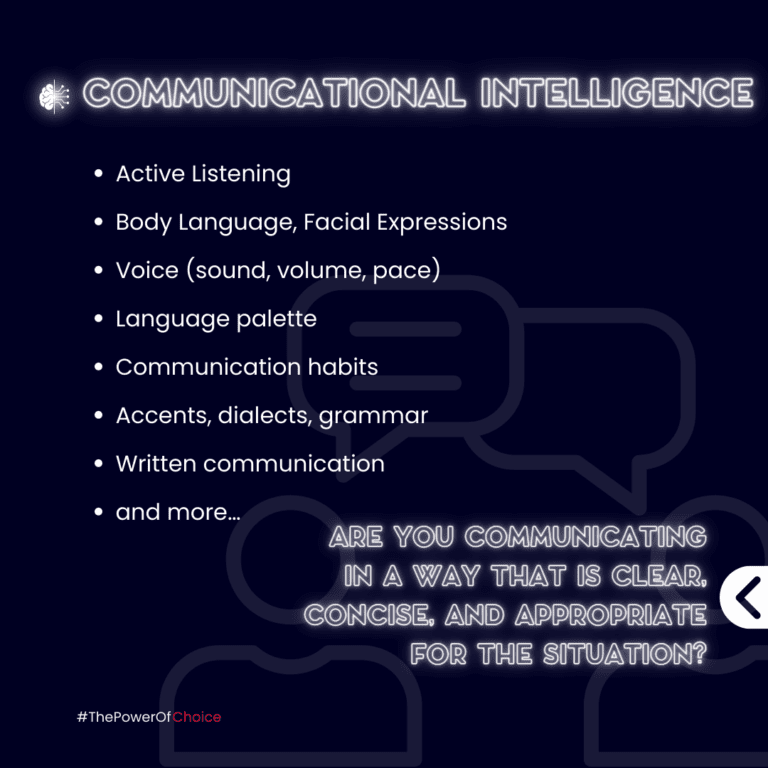
Communication is the transfer of information from one person to another: spoken, nonverbal, written, even visual. None of it is simple, because there is always a sender, a receiver and a message whose meaning can change depending on the context and on how it was sent and received. Aspects of your communication include:
- active listening
- body language and facial expressions (posture, gestures, movement, touch)
- voice (sound, volume, pace)
- your language palette
- communication habits
- accents, dialects, grammar
- written communication
- and more
Decision-makers rely on communication to gather information and decide. How you communicate influences what they believe about your character, values, beliefs, trustworthiness, intelligence and credibility. So consider how you present yourself verbally and nonverbally, the language you use and how you come across in writing and visuals. Are you clear, concise and appropriate for the situation? Are you aware of cultural differences, language sensitivities and your own unconscious biases?
044. Digital intelligence: what does your footprint say?
Digital intelligence covers the messages you share online, the pictures on your social media profiles and the way you interact with people online. It shapes the digital presence that follows you to work and the impression it leaves.
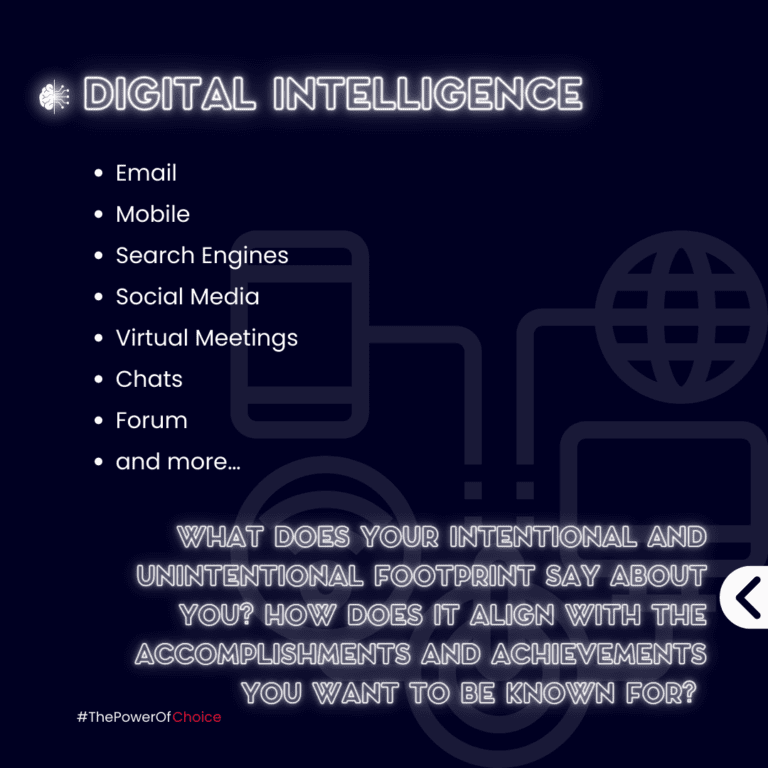
It refers to all the information about you that exists online because of your activities. That trail can be left intentionally or unintentionally, actively or passively. Either way, your footprint is close to permanent. Once data is public, you have little control over how others use it, and it can shape how people perceive you long before they meet you. Aspects of your digital footprint include:
- mobile
- search engines
- social media
- virtual meetings
- chats
- forums
- and more
Your intentional footprint is how you present yourself through online profiles, websites and virtual meetings. Your unintentional footprint is everything else your activities leave behind, such as search results and cookies. The first you can manage and control. The second is harder to manage, and it still shapes how decision-makers see you.
Decision-makers often research potential employees or partners online before they decide. So monitor your footprint actively and make sure it represents you and your professional brand: use privacy settings, limit the personal information you share and skip unprofessional posts. Does your footprint reflect the accomplishments you want to be known for? Does it speak to your target market? Stage it on purpose. More in the digital footprint you curate and the one you overlook.
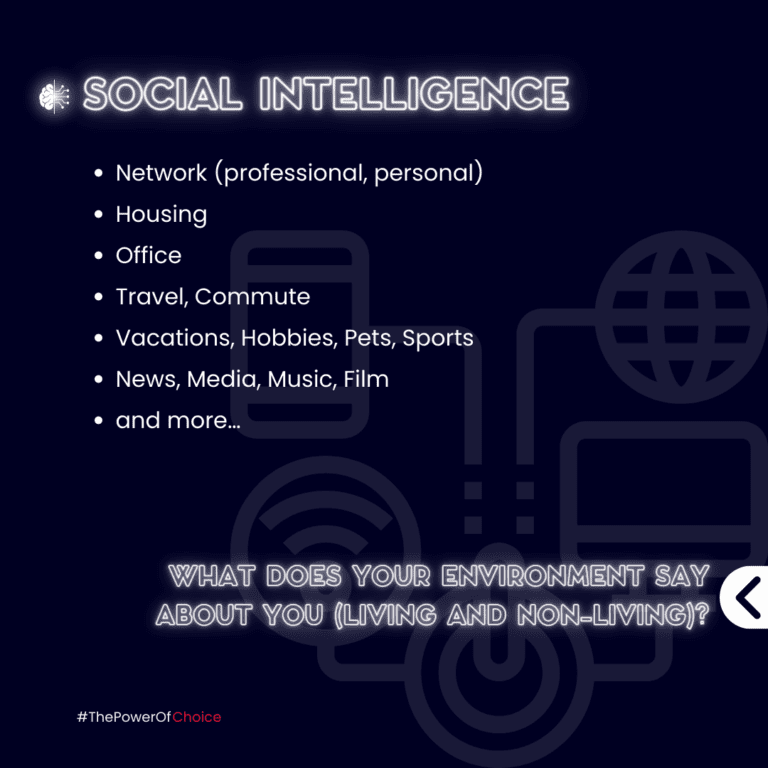
055. Social intelligence: what does your environment say?
Social intelligence is about how you relate to the environment around you and how aware you stay of the social dynamics at play. It lets you adjust how you interact with people to get the most out of a situation.
Your environment includes everything around you, living and non-living. Both matter, because you adapt to the conditions of your environment, and those conditions influence your growth, health and progress. On top of that, others assume your environment shapes your physical, mental and moral development, so it becomes part of how they see you. Aspects of your environment include:
- your network (professional and personal)
- housing
- office
- travel and commute
- vacations, hobbies, pets, sports
- news, media, music, film
- and more
Decision-makers may be influenced by the environment you operate in, from your office space to your personal network. Ask what your surroundings say about you, and use them to support the message you want to send as a potential employee or partner.
Why the elements of emotional intelligence only work together
Successful staging always includes all five elements of your ABCDE. You cannot look one way and act in a completely different manner. It confuses people, and it distracts from what you actually offer: your performance and the results that drive your career and business.
You cannot look one way and act in a completely different manner. It confuses people, and it distracts from what you actually offer.
With attention to detail, clarity and consistency, and in a way that still feels comfortable and authentic to you, staging your ABCDE lets you build your professional brand in subtle, simple and powerful ways. Small doses, the right moments, and you capture the attention of decision-makers who have plenty of other people competing for it.
Every professional has a choice in how they present themselves at work. That is the idea behind my keynote The Power of Choice. Use these five elements well and you increase your positive impact on the people around you while reducing the negative. For more, read about emotional intelligence and first impressions and perception in emotional intelligence.
5 emotional intelligence tools in a nutshell


How You Resonate
The five elements in this article are the five dimensions at the heart of my course How You Resonate. It walks you through each one, and through all seven personas, so you can stage your ABCDE on purpose instead of on autopilot.
Frequently asked questions
What are the 5 elements of emotional intelligence at work?
In my framework, they are visual intelligence (appearance), behavioral intelligence (behavior), communicational intelligence (verbal, nonverbal and written communication), digital intelligence (your intentional and unintentional digital footprint) and social intelligence (your environment, from your network to your office). Together they form the ABCDE of how you are perceived.
How is this different from Goleman’s five components?
Daniel Goleman’s five components, self-awareness, self-regulation, motivation, empathy and social skills, describe what happens inside you. The ABCDE elements describe what others can see from the outside. Decision-makers judge your emotional intelligence through those visible signals, so both perspectives matter.
Why does appearance matter for emotional intelligence?
Because humans are visual. In seconds, people assume your success, capability, education and reputation from how you look. That is unfair, but realistic. Being aware of the signals your appearance sends, and aligning them with the professional you are, is a form of emotional intelligence.
What is an unintentional digital footprint?
It is the information about you that exists online without you actively publishing it, such as search results, tags, cookies and data others share. Unlike your intentional footprint, your profiles and posts, it is hard to control, yet decision-makers often see it when they research you.