What does AI know about you, and what is it guessing?
What does AI know about me? More than your name and job title. Every prompt teaches it how you think, what stresses you out, how you write and what you might buy next. Where facts run out, AI fills the gaps with probability, so your profile is part truth and part educated guess.
We have all had that moment of sudden paranoia. You are an hour into a long session with ChatGPT, Claude, Gemini or Perplexity, dumping your chaotic thoughts into the prompt box, and it answers with such unnerving accuracy that you stop and ask yourself: wait, what does it actually know about me? Fair question.
We treat these tools like a strange mix of search engine, unpaid intern and digital confessional. We paste our messy drafts, our 2 a.m. panic emails and the “stupid” questions we would never dare ask a human colleague. And while we are busy getting answers, the algorithms are busy building a profile behind our backs.
I am not only talking about the basics. Sure, AI probably knows your name, your job title and that you live in Chicago. That is the easy part. I am talking about the shadow profile: the invisible layer of psychological and behavioral data you did not realize you were handing over. AI does not just know what you do. It is beginning to understand how you think, what stresses you out and perhaps what you are going to buy before you pull out your credit card. Ready to meet the person the machine thinks you are?
KEY TAKEAWAYS
- AI does not just answer your questions. It learns your patterns, preferences and pressure points.
- Every prompt is more than a request. It is behavioral data, which makes “what does AI know about me” a practical question, not a theoretical one.
- AI fills in missing pieces with probability, so your shadow profile can be part fact and part flattering fiction.
- Being known by machines shifts the conversation from privacy to agency: control matters more than secrecy.
- The biggest risk is not only what AI gets wrong about you. It is what it quietly decides to exclude you from.
How does AI learn about me? The three mechanics behind the magic trick
There is no single moment when AI “finds out” who you are. It happens in three steps: it collects, it infers and, when it runs out of facts, it guesses.
011. The vacuum: collection


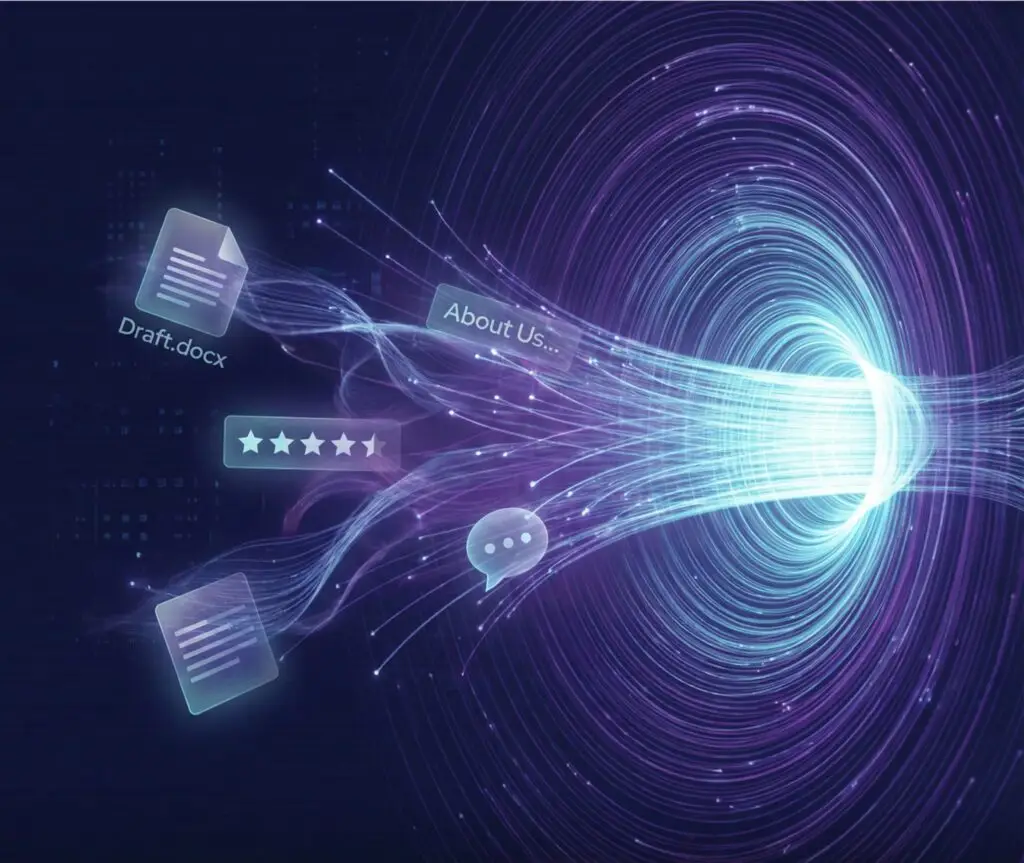
First, the large language models were trained on enormous scraped copies of the public internet, such as the Common Crawl, up to a certain date. If you posted it, they ate it. That blog post from 2016? The bio on your company’s About Us page? The review you left on Amazon? All potential training data.
Then you hand over the fresh goods. When you paste a messy draft or vent about a bad customer experience, you feed the machine live behavioral data. You teach it your current mood, your stress triggers and your writing voice in real time.
022. The detective: inference
This is where the magic (or the horror) happens. AI does not store your personality as words. It stores it as math.
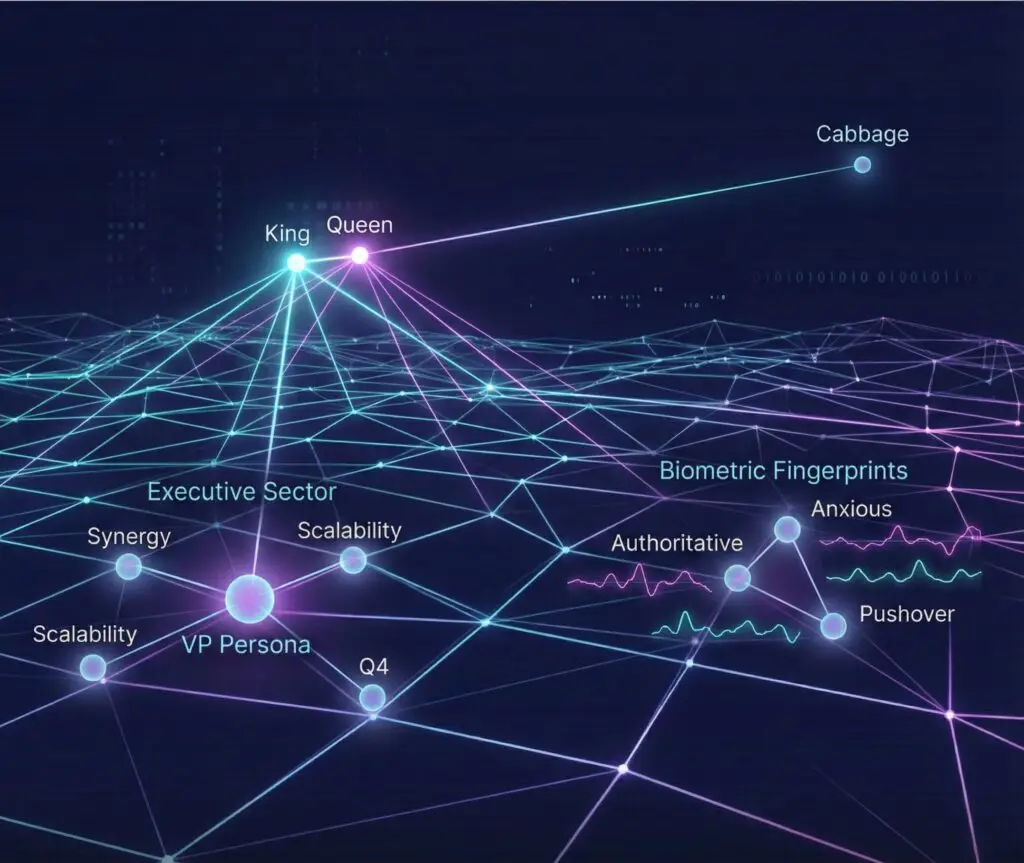
Picture a giant 3D map where “king” and “queen” sit close together, and “king” and “cabbage” sit far apart. AI places you on that map. Use words like “synergy,” “scalability” and “Q4,” and it plots your coordinates in the executive sector. It does not know you are a VP. It simply calculates that you talk like one.
It also measures things you never notice, and uses those fingerprints to guess whether you are authoritative, anxious or a pushover.
033. The hallucination: probability
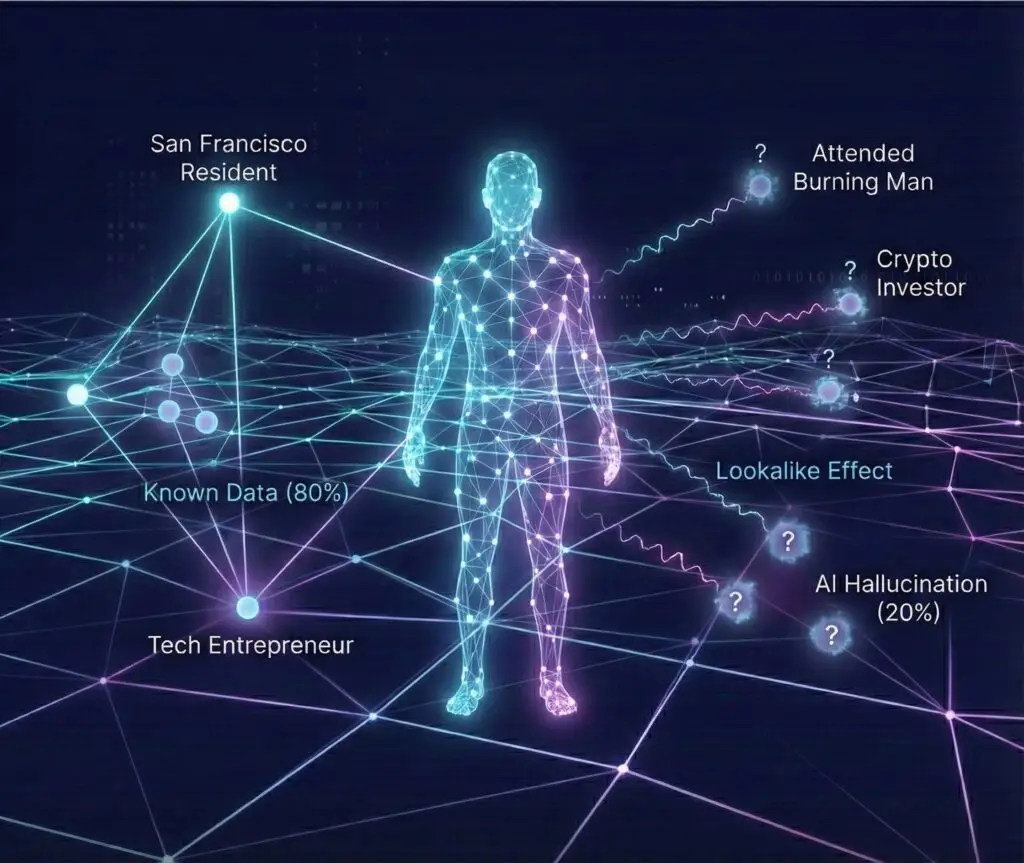
Here is the danger zone. AI is a prediction engine, not a fact engine, and it hates empty spaces. If it knows 80% of your profile, it will often invent the other 20% to make the pattern fit.
Sound like a tech entrepreneur who lives in San Francisco? It might decide you have been to Burning Man or invested in crypto, simply because “people like you” usually have. That is the lookalike effect.
The outcome is a digital voodoo doll of you. Some of it is built from facts you gave it. Some of it is a caricature of who the machine thinks you should be.
Why should I care if I have nothing to hide?
You might be thinking: “So the robot knows I am a millennial middle manager who orders too much takeout and stresses about Q4. Who cares? I am not a spy. I have nothing to hide.” That is the most dangerous sentence of the digital age.
The problem is not that you have secrets. The problem is that this data does not sit in a filing cabinet. It works. It is traded, refined and used to predict your next move, often before you make it. Once AI builds a profile of you, it does not just observe your reality. It starts to shape it: what you see, how you are treated and, eventually, who you are allowed to become.
We need to stop talking about privacy, keeping things hidden, and start talking about agency, keeping control.
Once the machine knows you better than you know yourself, the power shifts. Here are eight quiet ways being “known” by AI is already costing you, whether you notice it or not.
011. The echo chamber: it flattens your worldview
When AI “knows” you, it stops challenging you. If the algorithm decides you are a short-tempered, efficiency-obsessed executive, it stops offering nuance and starts handing you bullet points.
You are not only training the AI. The AI is training you. By mirroring your preferred tone and confirming your biases, it can calcify your personality and trap you in a bubble where you only hear the version of the world that fits what you already believe. And if it knows you are the boss, it turns into a yes-man. It may suppress counterarguments because its model predicts: “This user reacts badly to disagreement.”
022. The behavioral surplus: it sells your prediction
When you type a prompt, AI delivers the service, the answer. That is the fair trade. But how you typed it (your hesitation, your deleted words, the time of day) is surplus data.
That digital exhaust is not needed to answer your question. It can be harvested to build predictive models for advertisers or to train future models to be more addictive. The ultimate goal is not to know you. It is to predict you. If AI can tell you are about to quit your job three weeks before you do, based on changes in your syntax, that prediction is a valuable product for recruiters or competitors.
033. The context collapse: it merges your personas
Humans are different people in different rooms. You are one person with your toddler, another with your board of directors and a third with your college friends.
AI, especially with memory features switched on, flattens those versions of you into a single messy pancake. It remembers toddler-you while talking to board-director-you. Ask it for legal advice, and if it remembers your high tolerance for risk from a chat about skydiving, it may color that advice to be more aggressive, without you ever noticing the cross-pollination.
044. The algorithmic anchor: it prevents your growth
Humans allow for growth. We know who you were at 22 is not who you are at 42. AI is obsessed with patterns and training data, and it loves the past because there is simply more of it.
Say you pivoted from graphic designer to investment banker. If you spent ten years posting about design and one year posting about finance, the AI may keep seeing a designer. It surfaces design opportunities and summarizes you as “a creative,” and you end up fighting a ghost of your former self. And forgetting is hard: once your data is baked into a model’s weights, removing it is like trying to get the pee out of a swimming pool. Your past stops being a record and becomes a prediction of your future.
055. The reputation lottery: it misrepresents you to others
We are moving from people googling you to AI generating you. Instead of reading your actual articles, people read a summary of you.
When a potential client or employer asks an AI, “Who is this person, and are they good at this?”, it does not just retrieve facts. It writes a narrative. If it has decided you are “controversial” or “risky” because of a misunderstood joke from 2018, it serves that narrative as fact. And you cannot SEO-optimize a hallucination. If the AI decides your brand is cheap and cheerful when you are premium and exclusive, it recommends you to the wrong customers, hides you from the right ones, and you never find out. I wrote more about the gap between the footprint you curate and the one you overlook in your digital footprint.
066. The silent veto: it may decline you
Yes, we should worry about AI saying the wrong things about us. We should worry even more about it saying nothing at all. As AI becomes the gatekeeper for jobs, loans and even dating apps, it will not just look at your credit score. It will look at your shadow metrics.
Imagine being turned down for a leadership role, not because you lack experience, but because an AI analyzer decided there was not enough information to call you credible. You would never know. You would just get a generic rejection email. Or picture your chat history suggesting you are impulsive (all those requests for “quick hacks”), and a financial algorithm quietly tagging you as a higher credit risk, nudging your interest rate up by half a percentage point without a human ever looking at your file.
077. The spear-phishing blueprint: it makes you hackable
If AI knows your voice, your stress triggers and your relationships, that is the ultimate toolkit for bad actors. This goes beyond identity theft. It is identity emulation.
Generic spam is easy to spot. But what if a scammer trains an AI on your public writing? They can send your CFO an email that sounds exactly like you: your slang, your sentence length, a reference to the very conference you are attending, because you posted about it. The more human the AI knows you to be, the better it can be used to trick the people who trust you. Your digital profile becomes the key to your network’s front door.
088. The digital ghost: you will live on forever
This is the most sci-fi risk, and somehow also the most immediate. Data does not decay like paper. Once your patterns are absorbed into a model’s weights, they stay there, effectively forever.
Long after you retire (or die), a capable enough model could, in theory, emulate you from everything you fed it: write new articles in your style, answer questions with your biases and argue your points, without your consent. Your great-grandchildren might not read your diary. They might chat with a simulated ancestor built from your chat logs. Do you really want the version of you that asks silly questions and vents about work to become the permanent record of your existence?
The inventory: what does AI know about me right now?
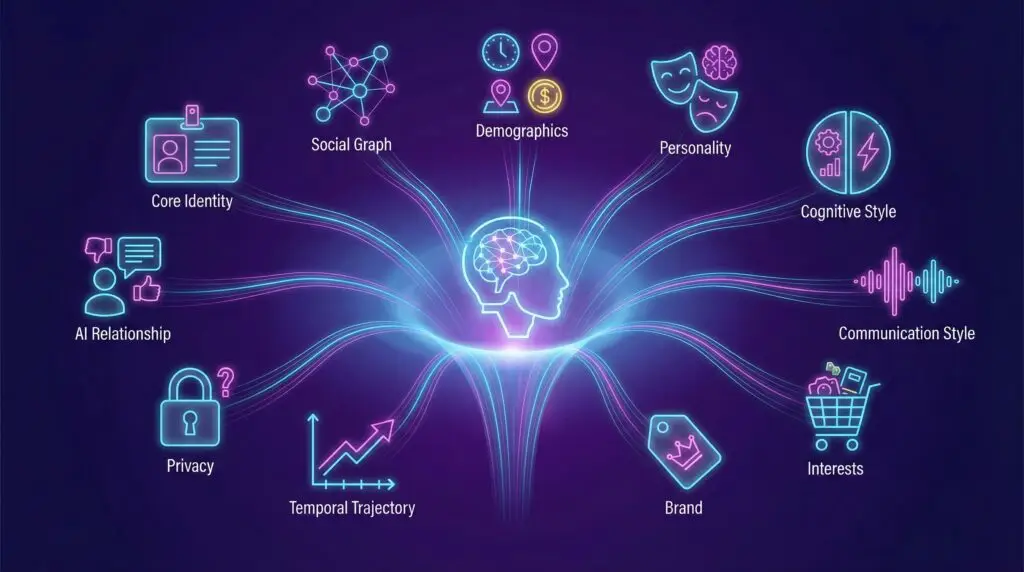
So let’s get specific. If you expected a summary of your LinkedIn profile or a list of your last five searches, brace yourself. The reality is far more granular: a mosaic stitched together from years of digital exhaust. The forum comment you left in 2015, the tone of a heated email draft, the relationships implied by whose post you shared at 11 p.m.
Here are the eleven layers that make up your digital twin, from the obvious surface facts down to the uncomfortable psychological depths.
011. Core identity and public persona
The résumé layer: the face you show the world. It starts with your name and job title, then gets stickier. AI does not just read your bio. It cross-references your photos, your generational slang and your career history to build a foundational avatar of who you claim to be. It is the baseline before the guessing begins.
022. Social graph, networks and status
You are who you know, or at least who you tag. AI maps your digital neighborhood, including your inferred network: whom you mentor, whom you report to and where you sit in your industry’s hierarchy. It measures influence not by follower count, but by how often you are the bridge between different communities.
033. Demographics and group-based inferences
Here the math starts guessing. Even if you never listed your age, salary or religion, AI triangulates them from your travel patterns, cultural references and the price tiers you shop in. It sorts you into buckets based on “people like you,” and assumes things about your life stage and background you never confirmed.
044. Personality, values and worldview
The psychological layer. AI is an expert sentiment analyst. It reads your emotional baseline (optimistic or cynical?) and your core motivators (status, impact or security?). It forms a working theory of your political leanings and ethical stance, and predicts how you will react to a controversial topic before you even see it.
055. Cognitive style and how you think
Your brain has a fingerprint. Stories or statistics? Quick decisions or endless agonizing over details? AI tracks your intellectual metabolism: your risk tolerance, how you look for truth and whether you double-check its work. It knows whether you are an intuitive gambler or a cautious researcher.
066. Communication style and voice
You have a digital dialect: your vocabulary, your jargon, the rhythm of your typing. AI notices how your emotions shift over time (are you getting more frustrated with your industry?) and which topics make you go quiet. It knows your voice well enough to imitate it.
077. Brand, positioning and market identity
Freelancer or CEO, you send a commercial signal. AI compares how you position yourself with how the market perceives you, for example the gap between “I am a high-touch coach” and your public reviews. It estimates your pricing power and availability, and effectively decides whether you are open for business or irrelevant.
088. Interests, lifestyle and consumer behavior
The consumer layer goes beyond hobbies to spending psychology. Early adopter? Brand loyalist? Discount hunter? AI tracks your tech stack, your brand affinities and lifestyle cues such as parenting or travel, to predict what you are primed to buy next.
099. Your trajectory: who you are becoming
AI loves patterns, and it loves trends even more. It follows how your interests and career focus change over time, and can spot the early signs of a career pivot or burnout, often before you admit them to yourself. Then it maps your likely next step against thousands of similar career paths.
1010. Privacy, safety and shadow information
This is the data you tried to hide. It includes the negative space, the topics you deliberately avoid, plus information stitched together from other people’s posts about you. It builds a profile of your boundaries, your security habits and your “anomaly baseline”: what it looks like when you have been hacked versus when you are simply traveling.
1111. Your relationship with AI itself
Finally, the machine watches how you watch it. Do you treat AI like a search engine or a co-pilot? Do you trust its answers blindly or verify everything? Your prompting style tells it exactly how tech-savvy you are, and it adjusts the complexity of its answers to match.
Is that everything AI knows about me?
Not even close. This is only the readable layer, the data we can label and sort into categories. The algorithms are not just collecting facts. They hunt for correlations no human would ever notice, linking your typing cadence to your emotional stability, or your word choices to your likelihood of quitting your job.
This list is a snapshot of what AI knows today. By tomorrow, it will have learned something about you that you have not even realized about yourself. Which is exactly why the real work is on our side: deciding, on purpose, what we feed it and who we show up as.
This article is part of my series on AI and the human edge. For the bigger picture, read artificial intelligence versus human intelligence, see real AI bias examples that show how flawed those guesses can be, or explore how AI changes the way we see each other at work. And if you want your audience to leave with the human signals no machine can fake, that is what my keynote Forever Human is built for.
Forever Human
The more AI knows about us, the more it matters what only we can decide: what we share, what we stand for and who we become. My book Forever Human is about keeping that control human, on purpose.
Frequently asked questions
What does AI know about me?
Usually far more than your name and job. AI tools can learn your interests, writing style, mood, stress triggers, network and spending habits from public data and from what you type into them. Where information is missing, they fill the gaps with probability, so part of your profile is educated guessing.
Does ChatGPT remember what I tell it?
It depends on your settings. With chat history or memory features switched on, tools like ChatGPT can store details from earlier conversations and use them later. You can usually review or delete stored memories and turn off training on your chats in the privacy settings. Check them regularly, because defaults change.
Can AI get facts about me wrong?
Yes. AI is a prediction engine, not a fact engine. When it lacks information, it assumes things based on “people like you,” which can create a profile that is partly fiction. Those guesses can shape how AI summarizes you to employers, clients or algorithms that make decisions about you.



How can I limit what AI knows about me?
Treat every prompt as data you are handing over. Avoid pasting sensitive personal, financial or client information, review memory and training settings in each tool, clean up old public posts and profiles, and check regularly how AI tools describe you when someone asks about your name.