Why does every new technology trigger the same fear?
AI feels unique because the technology feels unprecedented. The emotional response is anything but new.
Long before AI, Socrates warned that writing would destroy memory: if people could simply read information, nobody would bother remembering anything. The printing press brought that worry to a much larger scale. When radio entered people’s homes, many believed it would bring chaos into family life, with voices from the outside world suddenly filling the living room. Then came television, which would turn viewers into passive zombies and corrupt children’s minds. Decades later, the internet was going to spread misinformation, enable crime and destroy privacy forever.
Sound familiar? Each time, the same sequence followed. First, anxiety about how society would change. Then adaptation, as people learned to use the technology. Eventually, the innovation simply became part of everyday life. History does not tell us technology is harmless. It does show that humans are remarkably good at adjusting.
We panic first, we adapt second, and later we wonder why we worried so much.
Why does the fear of AI feel different this time?
Because, for many professionals, it feels personal. AI is not just another communication tool like radio or television. It performs tasks that used to require human thinking: writing, analyzing data, summarizing reports, even generating ideas. That raises an uncomfortable question. If machines can do these things faster, where does that leave us?
The answer lies in what AI actually changes. It is extraordinarily good at processing information and automating structured tasks. It organizes, calculates, summarizes and predicts patterns across vast data sets. What it cannot do is interpret what those patterns mean in the messy, emotional and unpredictable world of human interaction.
AI may generate a strategy. Humans decide whether it makes sense right now. It may draft a message. Humans decide whether the tone is right. It may highlight risks. Humans decide which ones truly matter. Once you see the difference between automation and judgment, the fear starts to look less like a threat and more like a transition. If the worry is specifically about your job, I wrote about that in AI and job anxiety.
Does technology replace people, or change their roles?
One of the biggest misunderstandings behind the fear is the idea that technology simply replaces people. History tells a more interesting story. Technology rarely eliminates human contribution. It moves it.
When calculators became common, accountants did not disappear. They spent less time calculating and more time advising. When spreadsheets replaced paper ledgers, finance professionals did not become irrelevant. They gained new analytical capabilities. The same thing is happening with AI.
AI is exceptionally good at removing repetitive, structured work: drafting basic reports, organizing information, processing large data sets. That frees space for deeper thinking: interpreting information, building relationships, solving complex problems, making strategic decisions. Technology automates tasks. Humans redefine value. So instead of asking “Will machines replace us?”, we can ask a far more useful question: “What becomes more valuable when machines handle the routine work?”
Which skills become more valuable as AI advances?
Something unexpected happens as AI gets more capable: the most human skills become the most valuable. Empathy. Judgment. Creativity. Ethical reasoning. Leadership. They rarely show up in data sets. They grow through experience, relationships and reflection.
Take leadership. A machine might analyze engagement scores and detect falling morale. A leader understands why the team feels uncertain after a restructuring announcement. Take creativity. AI generates variations of existing ideas. Humans imagine entirely new ones. Take trust. Clients may appreciate fast automated answers, but they build loyalty through relationships with people.
The future of work is not less human. In many ways, it is more human. I explore that in depth in artificial intelligence versus human intelligence.
How do you overcome the fear of AI?

Fear grows where familiarity is missing. The more mysterious a technology feels, the more intimidating it becomes. So one of the most effective remedies is surprisingly simple: use it. Here are five ways to move from anxiety to curiosity.
1. Start with exploration, not expertise
Many people believe they have to understand AI fully before they can safely use it. That keeps them in observation mode, watching others experiment while their own uncertainty quietly grows. Familiarity does not come from studying a technology from a distance. It comes from interacting with it. Ask an AI tool to summarize an article, brainstorm a few rough ideas or outline a presentation you are already planning. The goal is not perfect work. The goal is comfort. Once you see where it helps and where it falls short, the mystery fades, and you realize you are still the one directing the process.
2. Focus on collaboration, not competition
The fastest way to intensify the fear is to treat AI as an opponent. Ask “Can AI replace me?” and every new capability feels like a threat. Ask “How could AI help me?” and the dynamic changes. You start finding ways to save time, generate ideas faster and simplify complex work. Competition turns into experimentation, and experimentation usually shows that human judgment still guides the outcome.
3. Learn what AI does poorly
Knowing what AI can do is useful. Knowing what it cannot do is liberating. Much of the fear comes from assuming the technology can do far more than it actually can. Pay attention to where it struggles. It often misses context, misreads nuance or overlooks emotional signals humans catch instantly. It can produce technically accurate answers with no judgment or situational awareness. Once you see those limits, AI stops looking like an all-powerful replacement and starts looking like a powerful tool that still depends on human interpretation.
4. Strengthen your human skills
Ironically, one of the best ways to beat the fear has little to do with technology. It is investing in the capabilities that remain distinctly human. As automation grows, communication, empathy, leadership and strategic thinking become more valuable, because they help you interpret situations, build trust and make decisions that cannot be reduced to data. Invest in them, and AI starts to amplify your strengths instead of diminishing your value.
5. Stay curious
Curiosity may be the most underrated antidote to technological fear. Curious professionals approach new tools with questions, not conclusions. How does it work? Where does it help? Where does it fail? Curiosity builds familiarity, familiarity builds confidence, and confidence dissolves most of the fear that once felt overwhelming. The people who adapt best are rarely the ones who know everything. They are the ones curious enough to keep learning.
Is the future still human?
The fear of AI tells us something important about ourselves. It shows how deeply we care about purpose, identity and contribution. Work is not just a list of tasks. It is a source of meaning and connection. When technology changes how we work, of course we ask where we fit.
But humanity has stood at this point many times. Every major innovation felt disruptive at first. And every time, people found new ways to create value, build relationships and move forward. AI will change a lot about work. It will not remove the need for curiosity, judgment, creativity, empathy, leadership or imagination. It may make those qualities more visible than ever. The future will include powerful machines. It will still belong to the humans who know how to use them wisely.
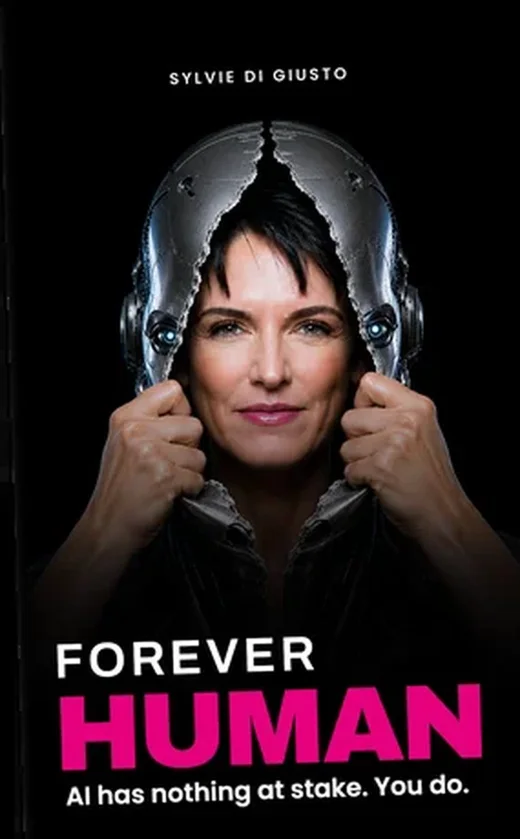
Forever Human
Fear shrinks the moment you know what only you can do. My book Forever Human names the moves no machine can make, so you can stop worrying about being replaced and start becoming the one people choose.