
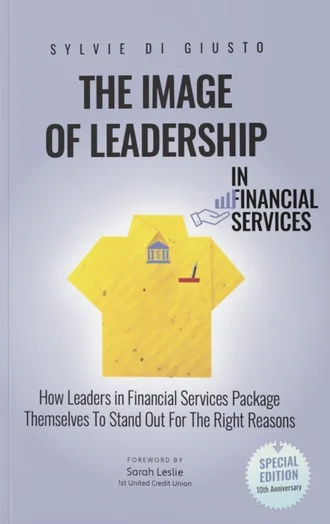
The Image of Leadership in Financial Services cover
The Currency of Influence

The Image of Leadership in Financial Services

In financial services, trust is the product.
Special edition · foreword by Sarah Leslie

Order on Amazon

Nobody hands their money to someone they doubt.

The Image of Leadership in Financial Services is written for the people entrusted with other people’s money and the teams who serve them. Before a client trusts you with their financial future, they first need to buy into you. This edition shows leaders in banking, credit unions, insurance, wealth management and fintech how appearance, behavior, communication, digital presence and environment earn that trust with clients, team members and upper management alike.

Any time you are handling other people’s money you need to show them that you are worthy of their trust.
Sarah Leslie1st United Credit Union, foreword to this edition

Who this edition is for

  • A tenacious team leader making first strategic decisions in a local credit union
  • A visionary C-suite executive steering a global investment or asset management firm
  • A newly promoted head of a wealth management team
  • An investment banking professional with sights set on a vice president role
  • A leader in retail banking or insurance who has to address a team member’s attire, hygiene or social media posts
  • A fintech founder pitching to venture capitalists and building a start-up’s credibility

The five signals, for Financial Services

AAppearanceWhat people see first, and keep seeing.
BBehaviorHow you act in the room, and when no one is watching.
CCommunicationThe verbal and nonverbal messages you send.
DDigitalWho you are online before anyone meets you.
EEnvironmentThe spaces and people you surround yourself with.
The opening story

William, Steven and the Vice President Role

William and Steven are competing for vice president at a Fortune 500 investment bank, a step that would define either career. On paper they are identical, with the same impressive track record in investment banking. Nancy, the chief operating officer, greets each of them in the lobby of the bank’s main building and walks them past the analysts and market data screens to her glass-walled office. William’s interview is polite and pointed, and after twenty minutes he is shown the door, feeling the opportunity slip away like water through his fingers. Steven’s conversation turns to a merger the bank is considering, pulls in the senior manager of the M&A division, runs a full hour and ends with an invitation to continue next week. The next day, Nancy tells the executive team that one candidate lacked conviction and the other exudes leadership. Same qualifications, same process. So what did Nancy see in the lobby before either man said a word, and what are your clients and team members seeing in you?

Chapter 1 tells you what happened next.

Inside the book

  1. Seven SecondsWhy clients ask whether they can trust you with their financial future long before they assess your acumen, told through two equally qualified candidates at an investment bank, and what a poor professional identity costs wealth managers, insurance brokers and compliance officers.
  2. Your Professional IdentityHow your professional identity becomes the cover others judge your whole story by, why a financial institution’s reputation rests on the identities of its leaders, and the ABCDEs: appearance, behavior, communication, digital footprint and environment.
  3. Leaders Look ConfidentThe confidence killers specific to financial services, from comparison and constant rejection to imposter syndrome, quota and pipeline pressure and the rapid pace of change, and how your look of leadership can shield you against them.
  4. Leaders Look AuthenticThe seven perception personas and where each fits in finance: the Traditionalist in central banking, compliance and established wealth management, the Cosmopolitan who may seem extravagant in a credit union, and the Dramatic on the trading floor.
  5. Leaders Look ProfessionalWhy rigid dress codes have blurred in financial services, the uniforms that still exist in bank branches and private banking, the unwritten uniforms of investment banking, fintech, insurance and private wealth, and the self-imposed rules that hold leaders back.
  6. Leaders Look RespectfulHow your visual presence signals respect for yourself, your team, your stakeholders and your institution, what to do when a team member arrives disheveled to a meeting about quarterly targets, and how to repair trust after a misstep.
  7. Leaders Look ControlledWhy finance is an emotionally driven minefield when markets fall, how your composure steadies clients and team members, and how self-awareness, self-care, self-promotion and daily scenario planning keep your look aligned with everything else you do.
  8. Leadership in a Digital LandscapeManaging the digital handshake that precedes every meeting, from your LinkedIn profile and webcam setup to your search results, plus the regulatory reality of what financial professionals can post, share or email.
  9. Leaders Lead by ExampleHow your professional identity sets an organic dress code for your team, the excuses you will hear (including “We’re in the suburbs, not Manhattan”), and how to hold sensitive conversations about attire, hygiene or social media posts.
  10. Moving ForwardWhy refining your professional identity is professional development rather than vanity, and what the potato chip on the cover teaches financial services leaders about packaging, expectation and earning a place at eye level.

Only in this edition

The invisible filters clients bring to the table

A client walks into a wealth management firm, waits a moment too long and notices worn chairs, and the verdict on the advice is formed before a single number is discussed. Sylvie shows how confirmation bias, anchoring bias and the horn effect shape how clients, team members and stakeholders judge financial leaders, where one hesitation on an investment question or a typo in a financial report can color everything that follows. Understood well, the same biases can be harnessed to work in your favor.

The sustained imprint: earning respect over time

Sylvie once trained a group of financial institution leaders in Europe with an unusual coach: horses. The group that commanded attention lost it as soon as their conduct became unpredictable, while the group that relied on treats and affection never gained it at all. Her conclusion: being liked is a bonus, being respected is the foundation, and predictability and consistency are what engender trust. For leaders who must stay composed through market volatility, the imprint that matters is the one you sustain every day.

Good is the baseline

In modern financial services, good no longer cuts it; it is the expectation. Sylvie uses Tetris to make the point: the piece that fits perfectly completes a line, and the line disappears. In a financial services career, aligning too closely with the patterns in play risks the same fate. This edition explains the right way to stand out: bring your best self, embody the highest values of your institution and surpass expectations, so you are remembered for your judgment and not for an incongruent detail.

One message for clients, colleagues and regulators

Appearance, behavior, communication, digital footprint and environment must all tell the same story, inside your institution and before investors, high-net-worth clients and industry conferences. In financial services, Sylvie notes, consistency is not only about trust but also about compliance: a firm that promotes ethical investing must reflect that commitment in every communication. She shows how one team member’s conduct at a conference, or a controversial post from an otherwise picture-perfect advisor, can raise questions about oversight, and how leaders make consistency a team standard.

Advocacy, not vanity

In an industry that rewards results, many high achievers still hesitate to talk about theirs. Sylvie draws a clear line between self-promotion and bragging, and shows why controlling your narrative raises the profile of your team as well as your own. She addresses the forces that hold leaders back, from fear of backlash and cultural norms to imposter syndrome, and invites you to act as the CEO of your own career, valuing progress over perfection instead of chasing goalposts that keep moving.

The conversations leaders avoid

Some of the hardest leadership moments in financial services happen behind a closed door: addressing personal hygiene, mismanaged emotions, a neglected workspace, disrespect toward stakeholders or an unfortunate social media post. Sylvie gives you a structured way through them: prepare with precision, consult human resources or legal counsel when issues carry legal implications, and choose a private setting outside peak operational hours. Keep the focus on the team member’s growth and on the institution’s reputation, and anticipate pushback in a high-pressure environment.

Questions readers ask

Why do equally qualified candidates get passed over for promotion in financial services?

Because identical credentials do not decide the outcome. The book follows two candidates for a vice president role at an investment bank whose résumés match exactly, yet only one is seen as a leader. Decision makers and clients alike evaluate you as a person before your financial acumen. A misaligned professional identity can stall promotions, bonuses and salary increases. Chapter 1, Seven Seconds, covers this in depth.

How do I become the go-to leader at my financial institution?

Being known for good work is not enough; it keeps you dependable but common. Sylvie outlines four visibility levels, from invisible to referrable, the level at which upper management recommends you for promotions and new roles without your direct involvement. Reaching it means working intentionally on your appearance, behavior, communication, digital presence and the people you surround yourself with. Chapter 2, Your Professional Identity, covers this in depth.

Do details like a watch or a wrinkled shirt really matter in finance?

In a field that prizes precision, they do. Clients entrusting you with their financial future read your attention to detail as evidence of how you manage their money, and a disheveled wealth manager risks a significant loss of trust. Accessories, a well maintained wardrobe and grooming are the finishing touches of an intentional look. Even investment banking's unwritten uniform relies on subtle accessories. Chapter 5, Leaders Look Professional, covers this in depth.

How should financial leaders behave during market volatility?

With visible calm and control. When money is at stake, fear, anxiety and panic often prevail, and clients look to you for guidance and reassurance. A leader who stays composed and gives clear, strategic advice helps ensure decisions are based on strategy rather than fear. Your team needs the same steadiness. If your behavior contradicts the confidence your presence suggests, trust erodes. Chapter 7, Leaders Look Controlled, covers this in depth.

How do I explain complex financial strategies to clients so they trust me?

Clarity and empathy carry more weight than jargon. Choose words that resonate with the client's goals, explain benefits and risks in a way that is easy to understand, and listen attentively so they feel valued and heard. Active listening, tone and body language matter as much as the words. When your communication matches the confidence of your presence, your credibility grows. Chapter 7, Leaders Look Controlled, covers this in depth.

What should financial professionals know about LinkedIn and social media?

Clients may research you online before engaging your services, and team members may look you up during a meeting. Search your name methodically across search engines, keep profiles current and connections reputable, and claim your name across channels. In financial services, a compliant footprint is a regulatory necessity: anything resembling advice must be vetted, and client information never shared. Chapter 8, Leadership in a Digital Landscape, covers this in depth.

Can my car or office affect how clients see me as a financial advisor?

Yes. A poorly maintained car can suggest carelessness, while an overly luxurious sports car may lead clients to question your financial judgment. An organized, functional office signals the professionalism and attention to detail clients expect from anyone handling their money. The people you associate with reflect on you as well, because you are judged by the company you keep. Chapter 7, Leaders Look Controlled, covers this in depth.

Can I order copies for my team or conference?

Yes. Preferred pricing is available for groups, conferences and client gifts, and signed copies are available on request. Many organizations pair the book with The Power of Choice keynote, which is built on it.

Is this edition available as an ebook?

Yes. The Image of Leadership in Financial Services is available in paperback and as a Kindle ebook on Amazon.

Around the clock

Still have questions? Ask Edna.

Edna

Ready to make your people impossible to replace?