Audience engagement is the speaker’s job after applause
Audience engagement is not automatic. It is earned. For a keynote speaker, it starts before you step on stage, depends on rhythm, story, participation and authentic energy while you are there, and is measured by what people do afterwards, not by applause. If attendees could have had the same experience watching a video, it was not engagement.
Before my life as a keynote speaker, I spent years in the corporate world, specifically in retail and tourism. I was lucky to work with a C-suite team who believed leadership was not about sitting in a glass office. They made sure we regularly stepped onto the front lines and experienced the business the way our employees and customers did. I spent days as a cashier, worked shifts in fulfillment centers and shadowed customer service teams handling real-time challenges.
That lesson never left me, and I apply it to speaking. I do not only stand on stages. I sit in audiences. I watch, I learn, and I experience what it is like to be on the receiving end of a keynote. What I have learned is simple: being an audience member is the hardest job in the room.
They have already had a long day. They are checking their email. They are thinking about what is next. They are fighting distractions and exhaustion, and, let’s be honest, sometimes they are just waiting for the coffee break. Keeping them engaged is not only about speaking well. It is about understanding what they need from you in that moment. So how do you make your time on stage not just tolerated, but truly valued?
KEY TAKEAWAYS
- Your audience’s time is the most valuable currency. Waste it and you have lost them before you begin.
- Engagement starts the moment your name appears on the agenda, not when you step on stage.
- Attention is earned and sustained through story, rhythm, emotion and participation.
- Technology should deepen human connection, never replace it.
- Your energy is contagious, and authentic energy beats forced enthusiasm.
- A keynote’s real impact is measured by the actions and conversations it sparks afterwards, not by applause.
Why is engaging the audience a speaker’s responsibility?
I do not have a TV at home. No particular reason. It just never got set up, and at some point I realized I did not miss it. So when I do watch something, it is a very intentional decision.
One evening, I chose a movie. Within minutes, I had a feeling I had picked the wrong one. After 15 minutes, I was sure it was a bad film. After 30, I knew my time was being wasted. And yet I kept watching.
Have you ever done that? Stuck with a bad movie because you had already invested the time? When it was over, I was so frustrated. Ninety minutes of my life, gone. Ninety minutes I could never get back. Ninety minutes that could have gone to something meaningful, productive or simply enjoyable.
Ever since, I think of that movie every time I walk on stage. Because as a keynote speaker, I am taking time from my audience. If I speak to 1,000 attendees for 45 minutes, that is 45,000 minutes of human life they will never get back. It is my responsibility to make every one of those minutes matter. At the heart of that responsibility is engagement. If people are bored, distracted or checked out, I am wasting their time and their chance to learn, grow and be inspired.
The stage is a privilege, not a right. Your audience owes you nothing, but you owe them everything.
Why do most keynotes lose the room in 10 minutes?
Attention spans are shrinking, but that does not make engagement impossible. It means you have to work smarter. The human brain craves novelty, stories and emotional connection. Deliver a keynote full of facts and bullet points and you are fighting an uphill battle.
Great keynote speakers do not just deliver content. They design experiences. They anticipate when the audience is likely to drift and build in moments that pull it back: a well-placed story, a shift in delivery, something unexpected. The rhythm of a keynote matters as much as the content. Knowing when to pause, when to surprise and when to invite participation is the difference between passive listeners and a room that is fully present.
I call this “changing the temperature” in the room. One speaker who has mastered it is Mark Scharenbroich, in my humble opinion probably the greatest keynote speaker of all time. One moment you are in tears over the self-reflection he just led you into, the next he lifts you back up with one of the funniest lines you have ever heard. He takes you on an emotional rollercoaster, from introspection to laughter, from depth to delight, without fancy technology, forced polling or gimmicks. Just pure mastery of human connection. That is the real magic: moving people in a way that stays with them long after they leave the room.
People do not disengage because they do not care. They disengage because you have not given them a reason to.
Does engagement start before you step on stage?
Many keynote speakers assume engagement begins the moment they walk on. That is a mistake. It starts long before the event: in how you position your message, in how the event organizer introduces you and in how you shape the audience’s expectations. The most successful speakers think beyond their own performance and weave their message into the audience’s experience from the very first touchpoint, whether that is the event website, the pre-event emails or how they support the organizers on their own social media. Every detail sets the stage.
So long before you step on stage, ask yourself:
- How can I help the organizers create anticipation and connection before I even begin?
- Which pre-event touchpoints can I contribute to that build excitement?
- What insights or resources can I share in advance so the audience arrives ready to connect with my message?
Keynotes do not start with a mic check. They start the moment the audience first hears your name.
How do you turn spectators into co-creators?
The days when audiences sat and listened politely are over. Today they expect interaction. They do not want to be talked to. They want to be talked with, and they want a role in shaping the conversation instead of merely absorbing it.
Engagement skyrockets when people feel like co-creators. The more they see themselves in the keynote, the more invested they become in the message, and the more likely they are to remember it and act on it. A few ways to get there:
- Live problem-solving: present a real challenge relevant to the audience and work through solutions together.
- Role reversals: invite attendees to take on different perspectives in a discussion or case study.
- Interactive storytelling: let the audience shape a story as it unfolds.
- Crowdsourced content: have attendees contribute insights that shape part of the presentation.
- Game elements: introduce playful, competitive moments like live polls, trivia or challenges.
- Visual exercises: use props, drawings or interactive whiteboards.
- Collaborative creation: build something together, whether an idea, a strategy or a collective takeaway.
- Surprise and delight: break patterns with unexpected, meaningful moments that keep people curious.
Master this and you do not just hold attention. You transform it. A truly engaged audience does not only listen. It internalizes, reflects and acts. The greatest keynote speakers measure their impact not by applause or feedback forms but by the long-term influence of their message.
If your audience could have had the same experience by watching a video of you, you missed the magic of live engagement.
Does interactive technology boost or kill engagement?
Polling apps, QR codes, AI-generated audience insights and real-time digital interaction have given keynote speakers more tools than ever. On the surface, they seem to amplify engagement with instant feedback, game mechanics and new ways to involve attendees. The reality is not that simple.
An audience clicking buttons or scanning QR codes is not necessarily an engaged audience. Technology can easily become a crutch, something speakers rely on instead of building genuine human connection. Used poorly, it creates distance instead of drawing people in.
Integrated with intention, though, it can change the experience completely. Imagine attendees submitting real-world challenges anonymously before a session so the speaker can tailor insights in real time. Or an AI-driven sentiment tool quietly guiding the speaker to adjust based on audience reactions. In those cases, technology does not replace engagement. It makes the experience more dynamic, personal and responsive.
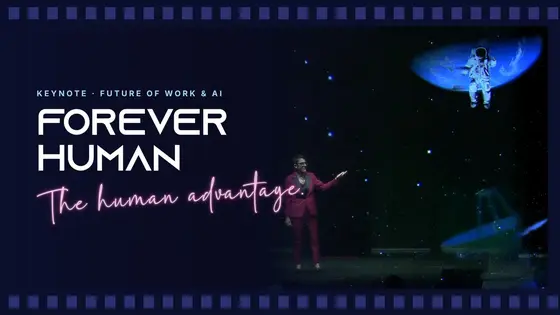
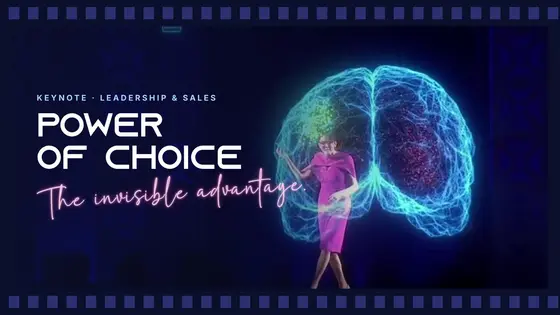
I have had the privilege of pioneering one of the most technologically advanced keynote formats in the industry: my 3D immersive experience. It lets me bring ideas to life in a way that captivates audiences like nothing else, blending visual storytelling with futuristic innovation. But from day one, my priority has never been the technology. It has been the audience experience. The holograms are not there to dazzle for the sake of spectacle. They are there to deepen understanding, spark curiosity and make the learning more memorable. Because no level of technical sophistication can replace what truly matters: the human connection between speaker and audience.
Technology should serve the audience, not the other way around. The most powerful keynotes do not hinge on interactive slides or polling. They hinge on storytelling, emotion and human connection, and no app in the world can replicate that.
If technology does not deepen the conversation, it is just a distraction dressed up as innovation.
Why is a speaker’s energy contagious?
Engagement is not only about what you say. It is about what you radiate. Before you say your first word, your energy has already set the tone. Walk on with hesitation, low enthusiasm or a distracted presence and your audience will mirror it right back. Step on stage fully engaged and fully present and you get a completely different response.
Your audience picks up on everything: your posture, your tone, your expressions, the conviction in your voice. As in any human interaction, they take their cue from you.
This is not just motivational speaker talk. There is science behind it. Humans are wired for emotional contagion, the psychological phenomenon in which people unconsciously mirror the emotions and energy of those around them. When one person in a room radiates enthusiasm, confidence and positivity, others start to match that frequency. The same goes for nervousness, disengagement and monotony.
As a keynote speaker, you are the emotional thermostat of the room. The audience regulates itself to your energy, so if you want engagement, you have to embody it first.
That does not mean audiences need a hyped-up, overly animated performance. They need you to be fully invested in what you are saying. Forced enthusiasm is just as off-putting as low energy. What works is authentic energy that matches your personality, your message and the moment.
Ever been in a room where the speaker was so genuinely invested that you felt compelled to lean in? That is the engagement that lingers. It is not about being the loudest, flashiest or most high-energy person in the room. It is about being the most present, the most attuned and the most connected to the people in front of you.
Authenticity beats theatrics every time.
How do you extend audience engagement after the keynote?
A great keynote does not end when the speaker leaves the stage. It keeps sparking conversations, inspiring action and influencing thinking long after the event. True engagement is not only what happens during your talk. It is what lingers afterwards. The best speakers do not aim for applause. They aim for impact. Here is how to build engagement that outlives your time on stage:
- Leave a challenge or a concrete next step. A speech without a takeaway is like a book without an ending. Give people a challenge, a question to reflect on or an action they can take immediately, and make it clear how to apply it. If they do not act, they forget.
- Make it easy to stay connected. A resource or worksheet tied to your keynote, a QR code leading to further insights or an online discussion, a newsletter for those who want to go deeper, or social media where they can keep engaging with your ideas. The less friction, the more follow-through.
- Collaborate with organizers on follow-up content. Your role is not just the 45 minutes on stage. It is helping the event create lasting impact. Offer post-event content such as a short video recap or a LinkedIn post summarizing key insights, or answer audience questions in a follow-up email or online forum.
- Encourage people to share and reflect. The best engagement happens between audience members, too. Ask attendees to share one takeaway with a colleague, post their favorite insight or apply a specific strategy and report back. When people articulate what they learned, they reinforce it.
- Offer ways to keep learning. A book, course or workshop that expands on your talk, a self-reflection tool that personalizes the learning, or a community where the conversation continues. This is not about self-promotion. It is about giving people the tools to turn inspiration into action.
- Follow up and stay part of the conversation. Most speakers walk off stage and move on to the next event. The best ones stay engaged: they comment on event recap posts, thank attendees and answer the people who reach out with a question or an insight.
Engagement does not end when the applause fades. It continues if you build it to last. That is the measure of a speaker’s true influence: not how well they spoke, but how deeply their message took root.
Is a standing ovation a sign of real engagement?
A standing ovation feels great. But does it mean your audience was engaged? Not necessarily. The true measure of engagement is not applause. It is action. What do people do after they hear you speak? Do they talk about your message? Apply your insights? Share the experience with others?
I once sat in on a fellow speaker’s presentation and watched him orchestrate a “standing ovation” with remarkable precision. At the end of his talk, he had the entire audience rise, under the impression it was part of an engagement exercise, and used that moment as his exit, leaving the stage to a room already on its feet. He proudly calls himself the keynote speaker with the most standing ovations worldwide. How meaningful are they really?
If engagement does not extend beyond the applause, it was not real engagement. It was good theater.
Standing ovations mean nothing if they do not turn into lasting impact. If people rise out of habit, peer pressure or because they were prompted to, that is not engagement. It is choreography. Real engagement is measured in the ideas that linger, the conversations sparked and the actions taken long after the event ends.
If all you wanted was a standing ovation, you should have given them a concert.
For more research and ideas, see the scholarly article Audience Engagement Techniques in Oral Presentations, which describes five techniques to turn passive listeners into active participants, and Duarte’s 11 audience engagement strategies for all presentations.
Planning an event? Read how to choose your opening and closing keynote and whether experiential keynote speakers are the answer to event fatigue.
Frequently asked questions
How do you engage a hybrid audience?
Treat remote attendees as equals, not an afterthought. Address them directly, use polls, chat and live questions, and consider a moderator who relays their input. For the people in the room, keep eye contact, move with purpose and create shared moments. Design engagement for both groups from the start.
What are the biggest mistakes that kill audience engagement?
Talking at the audience instead of with it, overloaded slides, jargon and failing to connect early. Another big one is ignoring energy dips and plowing on. Relying on gimmicks or forced participation can also backfire. People engage most when the content is truly relevant to them.
How do you win back an audience you have lost?
Act quickly. Pause and acknowledge the moment with a question, a light comment or a surprising shift in delivery. Tell a story, move, or ask the audience for input. Changing your pace, voice or format can pull attention back. The worst choice is to carry on as if nothing happened.
How do you measure audience engagement after a keynote?
Look beyond applause and feedback scores. Track what people do afterwards: whether they quote the message, discuss it with colleagues, share it online, use the follow-up resources or apply a specific strategy. Ask the organizer to check in with attendees a few weeks after the event.