Fun ways to introduce yourself that people actually remember
The most fun ways to introduce yourself swap a flat label for a small, specific story. Not “I work in IT,” but “By day, I’m a cybersecurity wizard, keeping companies safe from hackers.” One vivid detail gives people something to remember, something to ask about, and a reason to keep talking.
An introduction can make you the star of the show, or just another face in the crowd. It is the moment paths cross, and it quietly decides whether you are a fleeting encounter or a lasting thought in someone’s mind.
Think of it as the Big Bang of your interpersonal universe. Everything that follows starts here. So let’s look at why introductions matter so much, and then at 36 ways to make yours unforgettable.
KEY TAKEAWAYS
- People form an opinion about you within seconds, so your introduction carries much of your first impression.
- A compelling introduction is social currency: it buys you attention, interest and real engagement.
- Your introduction is your first chance to control the narrative about who you are.
- Specific details beat labels: one vivid image is easier to remember than a job title.
- Even sensitive topics, like a career transition, can be framed with honesty and optimism.
Why does your introduction matter so much?
The psychology behind it
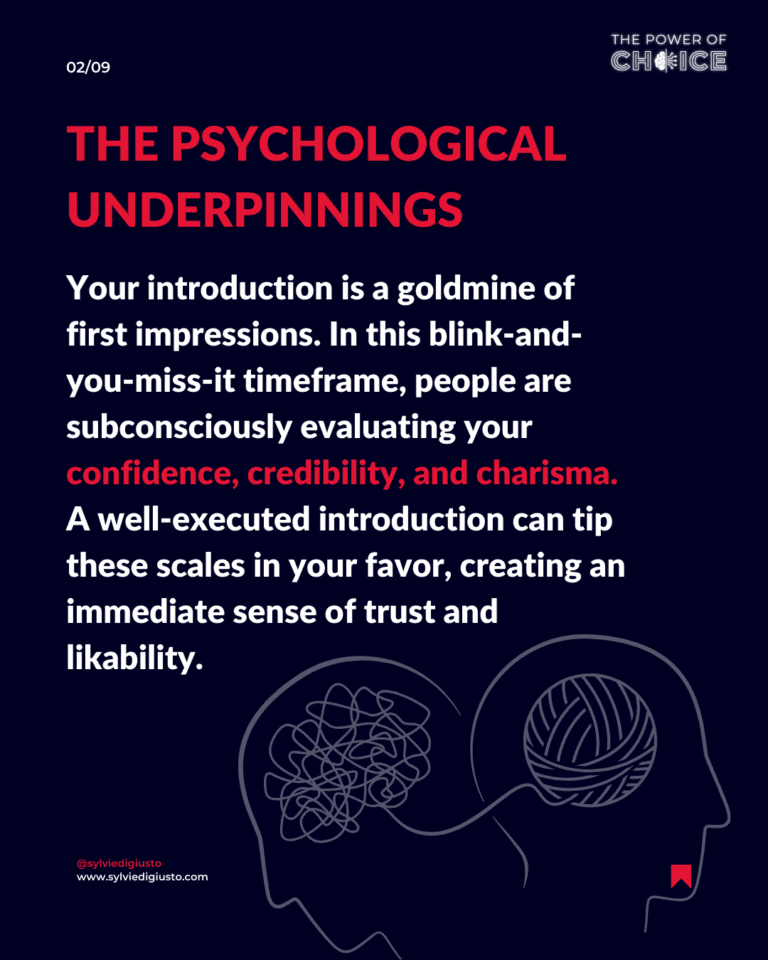
From a psychological standpoint, the introduction is a goldmine of first impressions. If you follow me, you already know it takes just 7 seconds for someone to form an opinion about you. In that blink-and-you-miss-it window, people subconsciously evaluate your confidence, credibility and charisma. A well-executed introduction tips the scales in your favor and creates instant trust and likability.
Your social currency
In the social marketplace, your introduction is your currency. You trade it for attention, interest and engagement. A compelling one makes you someone people want to invest time and energy in. A bland one devalues your stock, and people politely move on to the buffet.
Narrative control
Your introduction is also your first opportunity to control the narrative about who you are: your opening statement in the court of public opinion. It sets the tone, establishes your identity and steers the conversation toward what matters to you. You are writing the first chapter of your story. Make it so compelling that people want to read the rest.
The ripple effect
Your introduction is a pebble tossed into the lake of social interactions. The ripples can travel far beyond the first splash: to relationships, career opportunities and a better understanding of yourself. You are opening a door. Make sure it is one people want to walk through.
You are not just introducing yourself. You are unveiling your brand.
36 fun ways to introduce yourself, with examples
Here is the same information, told two ways. The first version is what most of us say. The second is what people remember.
General introductions
- Instead of: “Hi, I’m John. Nice to meet you.”
Try: “Hello, I’m John, the guy on a quest to make the best homemade pizza. Pleasure to meet you.” - Instead of: “I’m just here to see what this event is about.”
Try: “I’m here to explore new perspectives and hopefully make some lasting connections.” - Instead of: “Well, that’s me. Nice talking to you.”
Try: “That’s a little about me. I’d love to hear your story too.”
Your profession
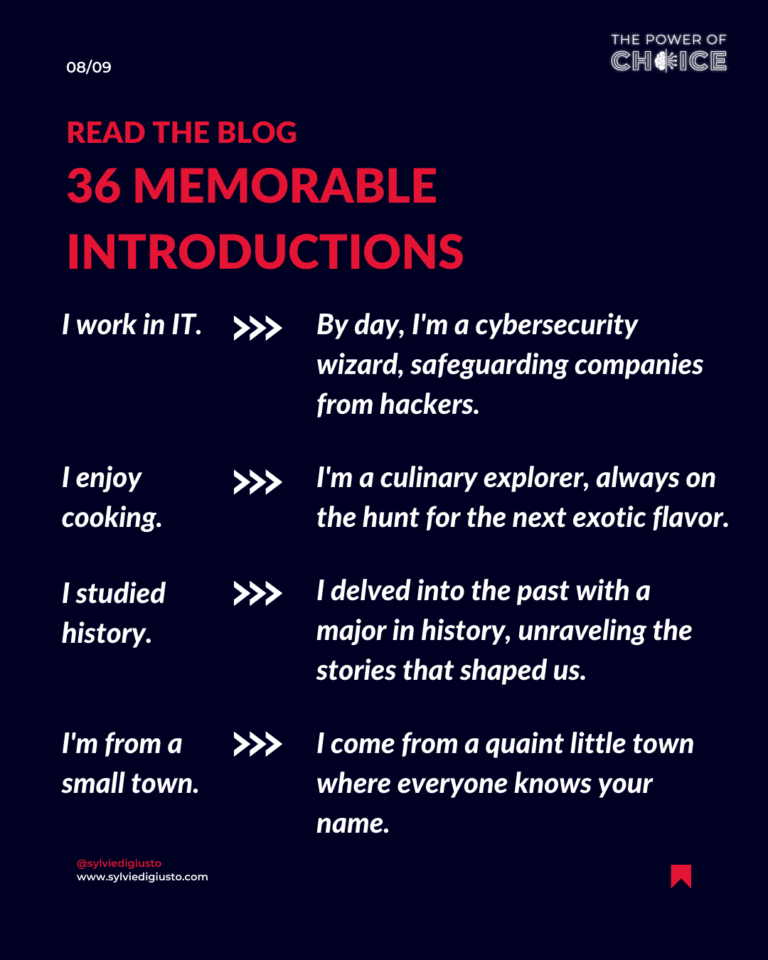
- Instead of: “I work in IT.”
Try: “By day, I’m a cybersecurity wizard, keeping companies safe from hackers.” - Instead of: “I’m a teacher.”
Try: “I shape young minds and future leaders as an elementary school teacher.” - Instead of: “I’m a student.”
Try: “I’m a psychology major, exploring the mysteries of the human mind.”
Your hobbies
- Instead of: “I enjoy hiking.”
Try: “I’m an avid hiker who conquers a new trail every weekend.” - Instead of: “I’m into photography.”
Try: “I capture life’s fleeting moments through the lens of my camera.” - Instead of: “I enjoy cooking.”
Try: “I’m a culinary explorer, always hunting for the next exotic flavor.”
Your educational background
- Instead of: “I went to XYZ University.”
Try: “I sharpened my analytical skills with a degree in Computer Science from XYZ University.” - Instead of: “I studied history.”
Try: “I majored in history, unraveling the stories that shaped us.” - Instead of: “I have a Master’s degree.”
Try: “I expanded my horizons with a Master’s in Environmental Science, focusing on sustainable practices.”
Your goals and aspirations
- Instead of: “I want to be successful.”
Try: “I’m redefining success by balancing work, health and family.” - Instead of: “I want to make a difference.”
Try: “I want to leave a lasting impact by advocating for mental health awareness.” - Instead of: “I’m aiming for a promotion.”
Try: “I’m eyeing the next rung on the career ladder, with a plan and the drive to get there.”
Where you come from
- Instead of: “I’m from New York.”
Try: “I hail from the bustling streets of New York, the city that never sleeps.” - Instead of: “I’m from a small town.”
Try: “I come from a quaint little town where everyone knows your name.” - Instead of: “I’m from overseas.”
Try: “I bring a dash of international flair, originally from Paris.”
Your family
- Instead of: “I have two kids.”
Try: “I’m the proud parent of two future astronauts, or artists. They’re still deciding.” - Instead of: “I’m married.”
Try: “I’m happily on the adventure of marriage with my best friend.” - Instead of: “I’m single.”
Try: “I’m enjoying the single life while focusing on personal growth.”
Your current projects
- Instead of: “I’m working on something.”
Try: “I’m leading a project that aims to bring clean water to remote communities.” - Instead of: “I have a side hustle.”
Try: “I’m nurturing a side hustle that turns scrap metal into art.” - Instead of: “I’m writing a book.”
Try: “I’m writing a mystery novel that I hope will keep readers on the edge of their seats.”
Your beliefs
- Instead of: “I believe in doing good.”
Try: “I’m a firm believer in kindness and try to make a positive impact every day.” - Instead of: “I value honesty.”
Try: “Honesty is my compass in every interaction and decision.” - Instead of: “I’m spiritual.”
Try: “I find my balance through a blend of mindfulness and spiritual practice.”
Your skills and talents
- Instead of: “I can play the guitar.”
Try: “I can strum the guitar in a way that makes even the strings blush.” - Instead of: “I’m good at math.”
Try: “I can solve equations faster than you can say ‘Pythagoras.'” - Instead of: “I can speak multiple languages.”
Try: “I’m a polyglot who can order coffee in five languages, and counting.”
Your travels
- Instead of: “I love to travel.”
Try: “I’m a globe-trotter who has left footprints on five continents.” - Instead of: “I’ve been to Europe.”
Try: “I’ve sipped espresso in Rome and danced in the streets of Barcelona.” - Instead of: “I like road trips.”
Try: “I’m a road warrior who finds joy in the ride, not just the destination.”
Sensitive topics
- Instead of: “I’m unemployed.”
Try: “I’m in a career transition, exploring new opportunities to make an impact.” - Instead of: “I’m going through a divorce.”
Try: “I’m starting a new chapter in my life, focusing on personal growth and happiness.” - Instead of: “I dropped out of college.”
Try: “I took the road less traveled in education and learned through hands-on experience.”
How do you make your introduction memorable?
In a world teeming with people, standing out is no longer optional. A unique introduction starts a conversation, and it makes a memory.
Find the hidden gems within you
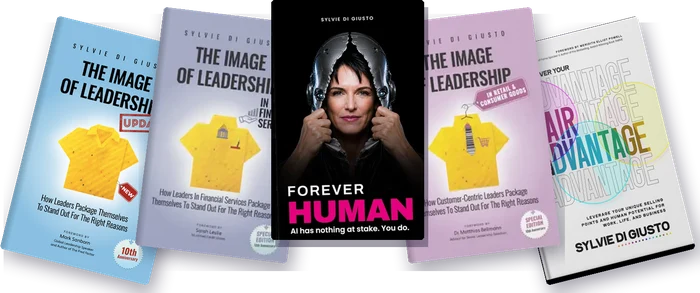
We often underestimate our own stories, talents and quirks. Speaking four languages or solving complex equations may feel “normal” to you. To someone else, it is fascinating. These traits are your social currency, your Fair Advantage in the marketplace of human interaction. They give your persona a distinct flavor and make you memorable and relatable. If you are not sure what makes you unique, or how to put it into words, that is exactly what my book Discover Your Fair Advantage helps you find.
Master the art of revealing
Choosing what to reveal is an art: a balance between mystery and openness. You do not want to lay all your cards on the table. But one nugget of unexpected information piques curiosity and invites the next question. It is especially powerful when you turn something that could sound negative, like a career transition, into a positive, framed as growth and exploration.
Your introduction is more than a polite formality. It is a snapshot of your identity and your chance to show what makes you, well, you. Next time you walk into a room full of strangers, remember that you are presenting your brand. Make it one people want to know more about. And once you have their name, keep it: here is why remembering names matters more than you think. For the other side of the stage, read how to introduce a presenter.
Let me introduce … myself
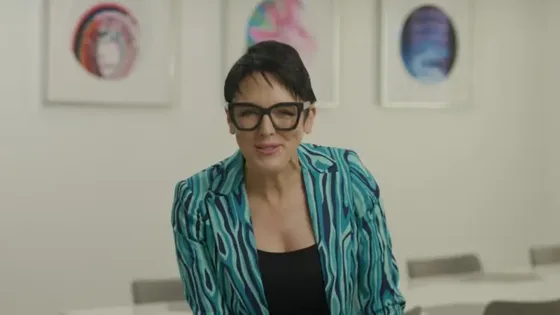
Below is my own video introduction. Spoken, written or on screen, the essence stays the same: leave a lasting impression. Go ahead, press play.
36 memorable introductions in a nutshell


Discover Your Fair Advantage
The best introductions are built on what makes you different. Discover Your Fair Advantage helps you uncover your unique selling points and put them into words, so “nice to meet you” turns into “tell me more.”
Frequently asked questions
What is a fun way to introduce yourself?
Replace a generic label with one specific, vivid detail. Instead of “I’m a teacher,” say “I shape young minds and future leaders as an elementary school teacher.” Add a hobby, a project or a quirky talent, and end by inviting the other person to share their story.
How do you introduce yourself in a memorable way?
Lead with something only you could say: a passion, a project, an unexpected skill or where you come from. Keep it short, specific and warm, reveal just enough to spark curiosity, and turn the conversation back to the other person so the exchange feels like a dialogue, not a pitch.
How do I introduce myself if I am unemployed?
Be honest and frame it with optimism. Say something like “I’m in a career transition, exploring new opportunities to make an impact,” and mention the kind of work or problem that excites you. It sounds confident, invites helpful follow-up questions and keeps the focus on where you are heading.
How long should a self-introduction be?
In conversation, a few sentences are enough, usually 15 to 30 seconds. Say your name, one memorable detail about what you do or love, and a question or invitation for the other person. You can share more once they show interest.