What changes when AI and leadership share the room?
The division of labor. Here are ten places where machines do something well and leaders still have to do something better.
1. The fastest answer is rarely the wisest decision

AI wins every race where speed is the goal. It screens thousands of transactions, applications or operational signals in seconds. It sends reminders, generates alerts and flags anomalies faster than any human team could respond. Processes that once took days now happen instantly.
Speed alone rarely solves a complex leadership problem, though. A machine sends automated reminders to every client whose policy is about to expire. A leader recognizes that one particular client needs a phone call, not another automated message. AI moves quickly. Leaders move wisely. Leadership often begins exactly where automation ends.
2. Remembering everything is not understanding anything
AI has a remarkable memory. It recalls every transaction, interaction and data point in a system, and surfaces patterns across years in seconds. Nothing is forgotten. But remembering information is not the same as understanding why it matters.
Leaders remember context: the difficult conversation that changed a project’s direction, the moment a client lost trust after a major claim, the unexpected support a partner offered in a tough market. Machines store information. Humans understand stories. And leadership decisions are shaped by relationships, context and lived experience, rarely by numbers alone.
3. Data teaches patterns, experience teaches judgment

AI improves through exposure to data. Feed it thousands of chess games and it masters strategy. Feed it millions of financial transactions and its pattern recognition sharpens.
Humans learn differently: through experience, failure and reflection. Leaders remember the project that collapsed despite promising forecasts and the client meeting that revealed a hidden risk long before the data did. They remember how situations felt: the pressure, the disappointment, the tension and the recovery. Experience creates wisdom. Data alone cannot.
4. Machines optimize the past, humans invent the future

AI drafts proposals, builds strategies and remixes existing ideas with impressive efficiency. Most of that output rests on patterns that already exist, and real innovation often means stepping outside them.
Leaders imagine possibilities that have never been recorded. They challenge assumptions and redesign systems instead of optimizing old ones. Breakthroughs usually start when someone asks an unconventional question or suggests an idea that sounds unrealistic at first. Machines rarely start those moments. Innovation takes imagination, courage and a willingness to explore what no data can predict.
Machines accelerate work. Humans define meaning.
5. Detecting emotion is easy, understanding people is leadership

AI is getting better at detecting emotion. It analyzes tone, sentiment and behavior, and can spot frustration in customer emails or falling engagement in employee surveys. Detecting emotion is not the same as understanding it.
Leaders sense what is not said. A client says everything is fine while their hesitation signals uncertainty. A team member claims to be confident while their silence suggests concern. Machines analyze signals. Humans interpret meaning. In leadership, what goes unspoken often matters more than what shows up in a report. (I go deeper into this in emotional intelligence for leaders.)
6. Perfect words mean little without timing and intent

AI produces beautifully structured emails, reports and presentations in seconds. Flawless grammar, clear structure. Effective leadership communication depends on nuance, not syntax.
Leaders weigh timing, tone, relationships and culture. A message that looks perfect on paper can create tension when it lands at the wrong moment or in the wrong setting. Machines assemble words. Humans communicate meaning, and the difference is never more visible than in sensitive conversations, where tone and intent decide whether a message builds trust or starts a conflict.
7. Algorithms follow rules, leaders defend values

AI works according to rules and models. If a performance metric declines, it might recommend replacing the lowest performer. If a client account becomes unprofitable, it may suggest ending the relationship.
Leaders ask deeper questions. What caused the decline? Is someone struggling with burnout, a personal crisis or a broken process? Is that unprofitable account actually a long-term strategic relationship worth protecting? Machines follow rules. Leaders follow values. Ethical judgment cannot be reduced to optimization.
8. Metrics show performance, humans sense momentum

AI monitors metrics continuously and with extraordinary accuracy: engagement scores, productivity patterns, operational indicators. A dashboard may reveal that a team’s performance is slipping.
Experienced leaders often sense that shift long before the numbers move. They notice a change of energy in meetings. They pick up fatigue, frustration or disengagement in everyday conversations. Machines monitor numbers. Leaders sense energy, and energy often predicts performance long before the data confirms it.
9. People do not follow dashboards, they follow leaders

AI can measure performance against targets and KPIs. Motivation rarely comes from metrics. Teams follow leaders because they trust them, believe in their vision and feel connected to a shared purpose, especially in hard moments when the data offers little encouragement.
Machines track progress. Leaders create movement. When an organization faces uncertainty, layoffs or rapid change, the ability to rally people around meaning matters far more than any dashboard. I explore this further in AI decisions vs human choices.
10. When the playbook breaks, leaders rewrite it

AI typically needs clear instructions or structured parameters. In an unexpected crisis, it relies on predefined models and existing playbooks.
Leaders improvise. When uncertainty hits, they experiment, adapt and design new solutions in real time. They connect ideas from different disciplines and find paths no manual ever described. Machines follow instructions. Humans work through ambiguity, and ambiguity is becoming the rule, not the exception.
What is the human leadership opportunity ahead?
AI will keep transforming how organizations work. It will analyze faster, automate more complex processes and deliver ever more sophisticated recommendations.
The goal was never to defeat the machine. The goal is to do what the machine cannot. Successful organizations will not choose between technology and people. They will understand the unique strengths of each. AI takes over the tasks that consume time and process information at scale. Leaders bring judgment, imagination, empathy and responsibility to the moments that matter most. It is not competition. It is cooperation.
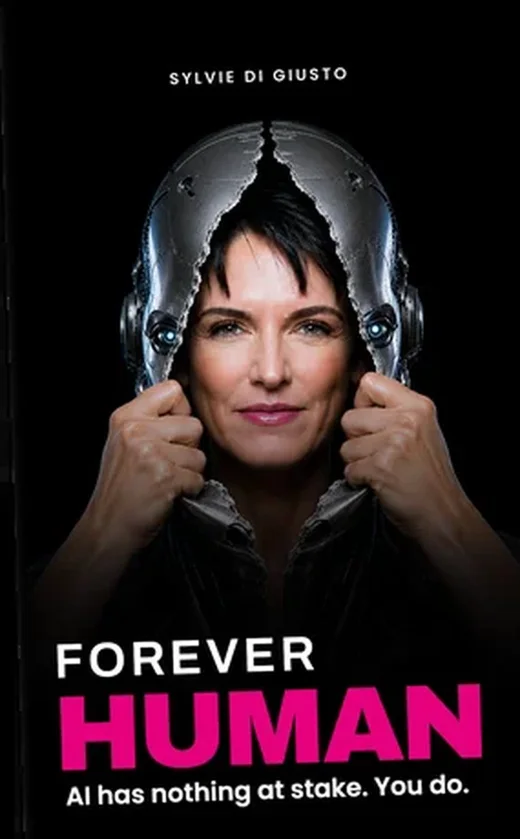
Forever Human
Ten differences, one conclusion: the better machines get, the more your leadership sets you apart. My book Forever Human turns that idea into the ten moves no machine can make, and how leaders master them on purpose.