The most common sales mistakes are rarely about the product
The most common sales mistakes are rarely about the product. They are about trust: not listening, not understanding what the client needs, overpromising, hiding fees, arriving late, sounding arrogant or delivering the same pitch to everyone. Clients decide early whether you have their interests at heart or only your commission.
In sales, your first impression is everything. People want to know they can trust you before they invest their money. They want to see that you have their best interests in mind and are not just chasing your quota.
Yet many sales professionals make the same mistakes over and over, and those mistakes quietly destroy their credibility before the deal ever has a chance. Here are the first 21 of the 42 most common ones, each with signs that you are getting it right. The other 21 are in part 2.
KEY TAKEAWAYS
- Clients buy from people they trust, and trust is built or lost in the first impression.
- Listening is not waiting for your turn to talk.
- Honesty about risks, fees and even your commission builds more trust than any pitch.
- Confidence sells. Arrogance does not. Humility is the difference.
- Every pitch, every term and every recommendation should be tailored to the client in front of you.
- If you cannot say what makes your product different, the client will choose on price.
Why do sales mistakes cost you the client?
Because clients rarely tell you. They simply do not call back. Each of the mistakes below sends a signal, and the client reads it as “this person is not on my side.” Fix the signal and you fix far more than one deal.
Clients rarely tell you why they did not choose you. They simply do not call back.
The first 21 sales mistakes
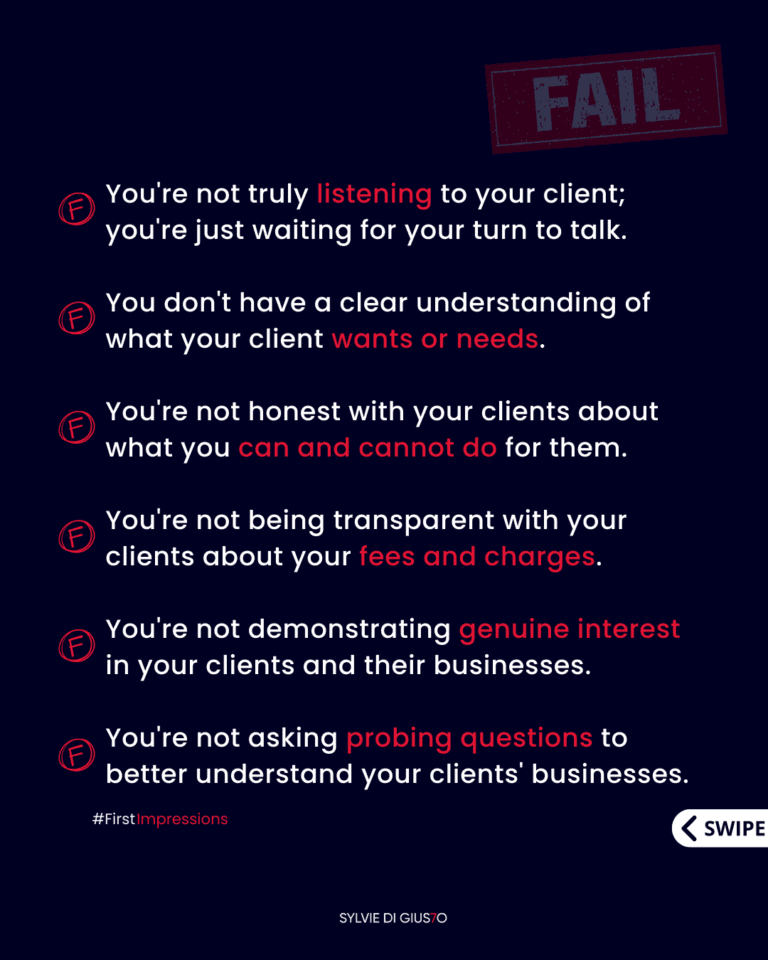
011. You are not listening to your client
Many salespeople give clients space to talk, but they are not really listening. They are waiting to say what they came to say. Pay attention, understand the message, pick up on the right cues and respond to what was actually said. You are listening if:
- you maintain eye contact
- you nod to show you are following and understanding
- you ask questions that go beyond yes or no, such as “What made you choose this product?” or “Can you tell me more about your experience with our company?”
- you paraphrase what the client said to show you absorbed it
- you take notes or record the conversation so you remember key details and can follow up
022. You do not understand what your client wants or needs
Finding out what your client wants is the whole job. It lets you choose the solutions that will make them happy with the result. Listen well and you will know which products help them reach their goals. You understand your client if:
- you ask questions that uncover their needs and goals
- you research their industry or business before you meet
- you anticipate problems they may face and offer solutions for them
- you share examples of how your products helped similar clients
- you follow up to make sure they are satisfied and offer more support if needed
033. You are not honest with your clients
Some salespeople make promises they cannot keep to close a sale. Most clients sense the lack of authenticity right away and walk. The rest find out later and kill the deal. You are honest if:
- you give accurate information about what you sell
- you acknowledge risks or downsides and suggest ways to reduce them
- you do not exaggerate benefits, and focus on the features that truly matter to the client
- you avoid pressure and manipulation
- you are upfront about your commission structure and how you are paid
044. You are not transparent about your fees
Quoting a low fee and then adding charges that inflate the bill rarely goes over well. To leave a positive, lasting impression, be upfront about every fee. You are transparent if:
- you give accurate pricing upfront, including any additional costs
- you explain payment terms and cancellation policies, including late payment or return shipping fees
- you break down each fee and show how it is calculated
- you offer discounts or concessions that help clients get the best value
- you offer flexible billing, such as monthly, bimonthly or quarterly, to make budgeting easier
055. You are not showing genuine interest in your clients
Clients can tell when you are not interested in their needs, and they will go elsewhere. Genuine interest in them and their preferences builds trust and rapport, and turns buyers into long-term customers. You show genuine interest if:
- you ask about their needs, goals and challenges
- you take the time to understand their unique requirements and circumstances
- you recommend what fits them instead of pushing a generic solution
- you ask for feedback, through surveys or conversations after a purchase
- you respond quickly to requests and concerns
066. You are not asking probing questions
The right questions tell you about the client’s business and needs. No questions tell the client you are not interested, which is a bad start to any relationship. Ways to probe:
- ask about their background, their interests and how they got into their industry
- ask about the needs, challenges or goals behind the purchase
- ask how purchasing decisions are made and who needs to be involved
- explore pain points with their current products and how they affect results
- ask open-ended questions that invite discussion and give you the full picture
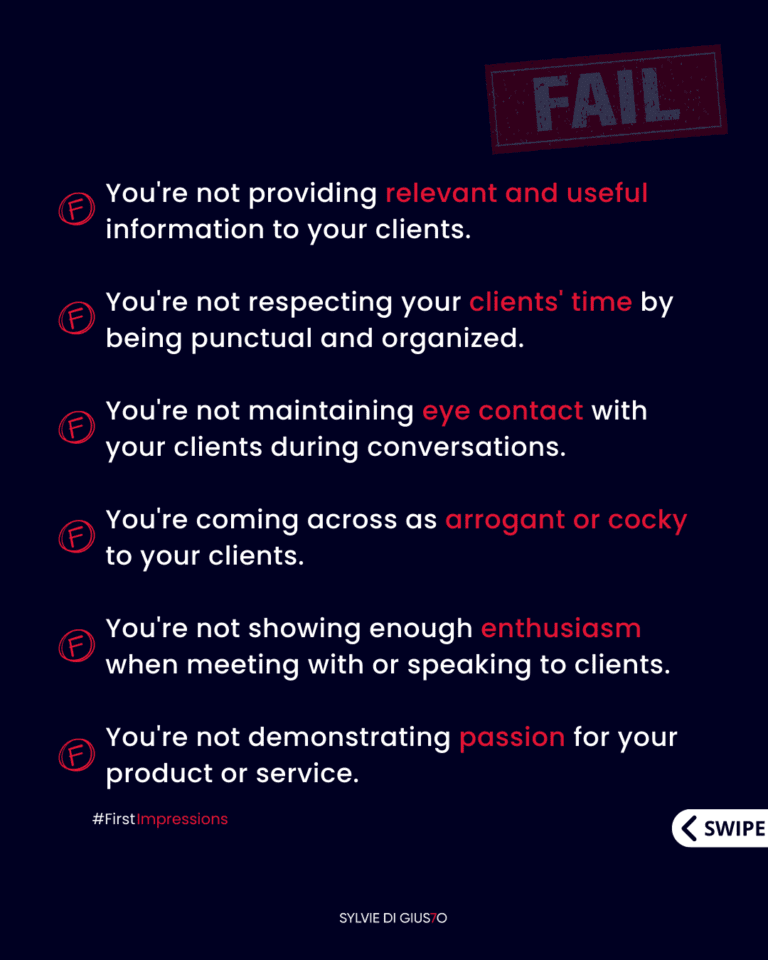
077. You are not providing useful, relevant information
Good salespeople educate. They share information that helps clients make smart decisions. Without it, the relationship stalls. Ways to add value:
- share relevant case studies and success stories
- pass on research, news and resources about trends and best practices in their field
- provide tools and reports that help them track progress
- offer training, webinars or workshops
- involve them in product development or market research, and share their feedback with your team
088. You are not punctual and organized
Show up late without the right materials and the client concludes they are not your priority and you are wasting their time. Plan ahead. You are punctual and organized if:
- you arrive on time, with everything you need
- you have a reliable system for appointments and deadlines
- you use to-do lists, calendars and workflow templates
- you keep your workspace orderly so you can find things fast
- you prioritize the most important tasks consistently
099. You are not maintaining eye contact
Avoiding eye contact can read as dishonesty. You do not want to stare a client down either, but looking them in the eye at the right moments is essential. Tips:
- watch your posture and body language so you look engaged and open
- do not look at screens or other people while you speak with a client
- consciously look away from your phone or computer from time to time
- speak slowly and clearly, and hold eye contact for roughly 60% of the conversation
- pause and reflect before you answer a question
1010. You come across as arrogant or cocky
Confidence is essential in business. Arrogance is fatal. The trick is the balance. To stay on the right side of it:
- listen actively and watch your own nonverbal cues
- never sound condescending or patronizing, however well you know your subject
- keep a positive attitude and focus on the value you add
- balance confidence with humility
- stay grounded, approachable, empathetic and willing to learn
1111. You are not showing enough enthusiasm
If you do not seem excited about the deal, why should the client be? A lack of enthusiasm reads as apathy and makes clients doubt you can deliver. You show enthusiasm if:
- you are energetic and engaged in meetings
- you clearly communicate the value you add to their business
- you share your ideas with energy, even when they differ from the client’s
- you respond to questions and feedback and actively move projects forward
- you stay positive when things go wrong
1212. You are not passionate about your product or service
If you do not believe in what you sell, nobody else will. Put your time and energy into a product or service you are genuinely excited about. You show passion if:
- you have a clear mission and values and bring purpose to every interaction
- you follow your industry so you can always offer cutting-edge solutions
- you keep exploring ways to improve your offer
- you enjoy learning about your clients’ businesses and adding value beyond your product
- you care about making every step of the sales process a good experience
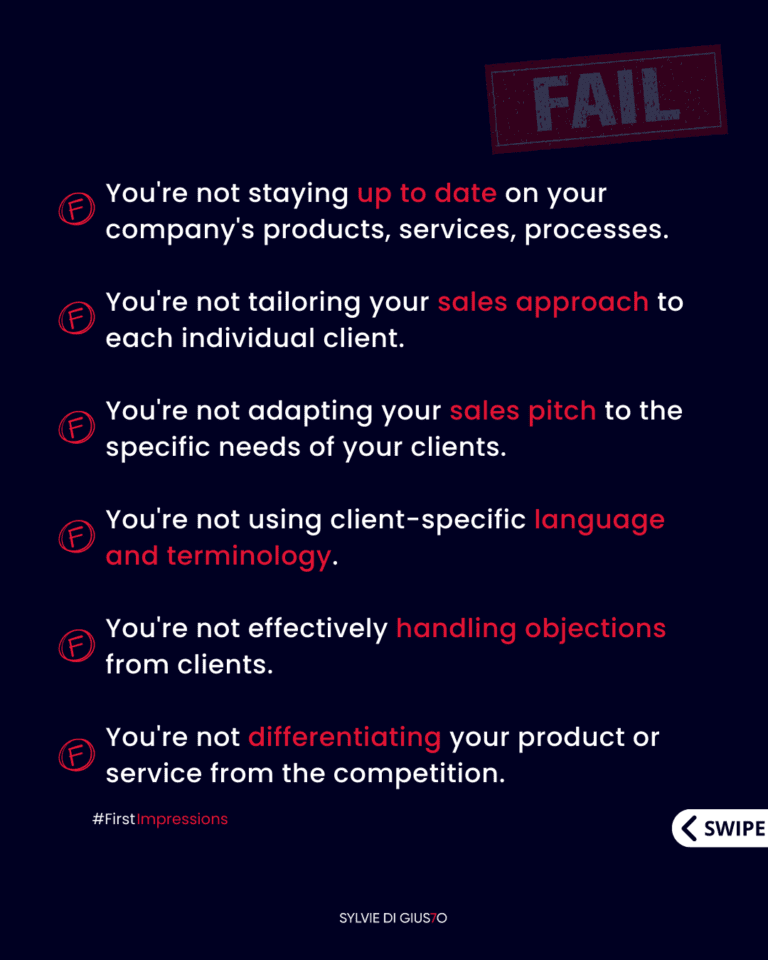
1313. You are not up to date on your products and services
It is embarrassing when the client knows your products better than you do. Stay current so you can always offer the latest. You are up to date if:
- you actively learn about new developments in your industry
- you track changes to existing products and tell clients proactively
- you attend conferences, seminars and networking events
- you keep a strong network of industry contacts who keep you informed
- you ask clients about their needs and preferences regularly
1414. You are not tailoring your approach to the client
Stay true to who you are, and still adapt to the client in front of you. You tailor your approach if:
- you research each client to understand their needs and preferences
- you listen in meetings and use what you hear to shape your pitch
- you adjust as you learn more, and are not afraid of small changes along the way
- you give customized recommendations instead of reciting a script
- you act as a partner invested in their success, not just someone closing a sale
1515. You are not adapting your sales pitch
Many salespeople have a template pitch. It should shift with the person and the product. Otherwise it sounds stale, includes irrelevant information and misses the client’s real interests. You adapt your pitch if:
- you refine it based on feedback from clients and colleagues
- you watch the client’s reactions and adjust in the moment
- you try new approaches to meetings and calls
- you are open to other techniques that may work better with certain clients
- you keep learning about your industry and sales best practices
- you focus on lasting relationships rather than a single close
1616. You are not using the client’s language
Your pitch should never be overly complicated. But if you avoid the terms of the trade entirely, you sound unfamiliar with the subject. Strike the balance between simplicity and jargon, and use the exact words your client uses for their needs and concerns. You are speaking their language if:
- you seek conversations with clients and let what they share shape your approach
- you review positive and negative feedback to learn which terms work
- you read their industry publications and blogs to keep up with trends and terminology
- you ask clients directly which terms they prefer
- you speak clearly and concisely, so the benefits are easy to grasp
1717. You are not handling objections well
Every salesperson needs a plan for objections. Never get angry. Have relevant answers ready that keep the deal alive, or risk losing it. You handle objections well if:
- you review your approach to address likely concerns before they come up
- you ask open-ended questions and listen to understand where the objection comes from
- you avoid blame and work with the client on a solution that works for everyone
- you have tools and strategies ready for common objections
- you admit when there is an issue, take the time you need and resolve it promptly
1818. You are not differentiating your product from the competition
If you cannot say what sets your product apart, you give the client no reason to choose it over someone else’s, and the deal goes to whoever is cheaper. You differentiate if:
- you regularly review your competitors: pricing, features and client reviews
- you can say precisely what sets your product apart
- you tailor your pitch to highlight those unique benefits
- you address honestly where you are less competitive, instead of only highlighting strengths
- you show the client why your product is the best fit for their specific needs
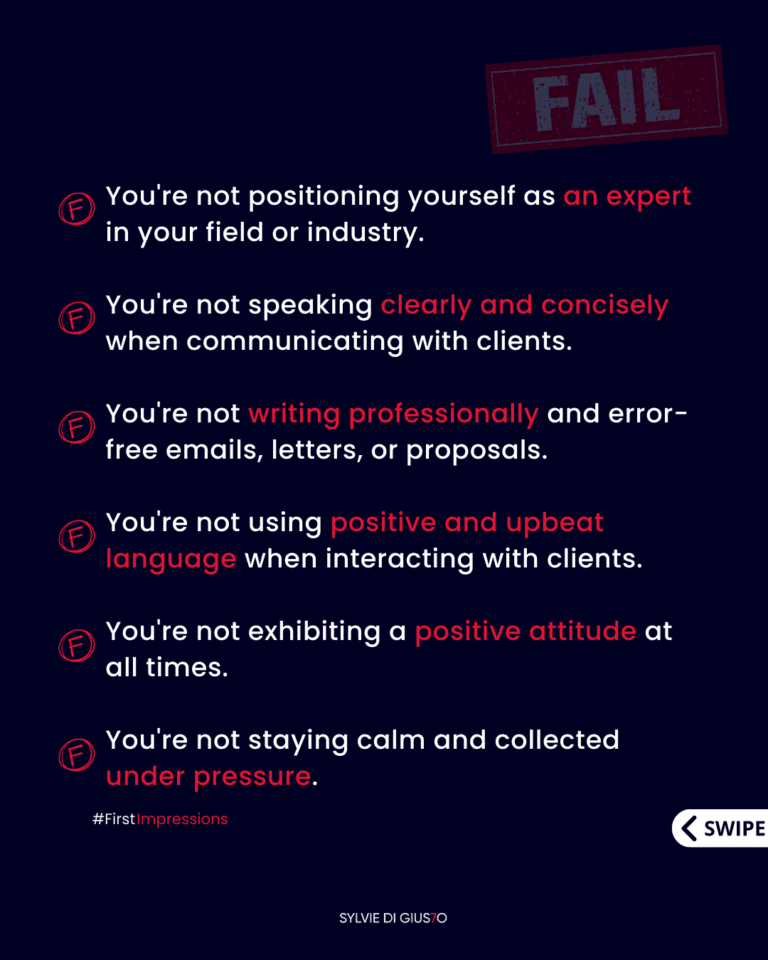
1919. You are not positioning yourself as an expert
Clients take advice from experts and invest with them. Share your knowledge and people are more likely to invest in your company. You are seen as an expert if:
- you keep learning about trends and developments, through blogs or industry conferences
- you share insights clients can act on in their business
- you stay active on platforms like LinkedIn and publish or join industry discussions
- you recommend other products, even a competitor’s, when they serve the client better
- you keep connecting with potential clients and stay top of mind
2020. You are not speaking clearly and concisely
Busy people want the bottom line in as few words as possible. If you do not express yourself well, they stop paying attention, and they do not buy. You are clear and concise if:
- you can explain complex ideas in a way that is easy to understand
- you use language and examples your client connects with
- you describe your products in plain words, without unnecessary jargon
- you explain how your product meets their needs and stay accessible
- you answer questions with real knowledge of your industry and product
2121. You are not writing professionally
So much of sales happens in writing now: texts, emails, direct messages. Poor grammar and spelling blur your point and make people think less of you. You write professionally if:
- you proofread before you send, checking for errors and ambiguous wording
- you format well, with bullet points or bold text where they help
- you include relevant links or attachments
- you keep a professional tone and avoid slang
- you adapt your style to the format and the industry
That is the first half. The next 21 common sales mistakes cover attitude, follow-up, your online presence and preparation. For the human side of selling, read emotional intelligence in sales and customer service and how unconscious biases influence your customers’ decisions.
Want your whole sales team to rethink how they get chosen? That is what my keynote The Power of Choice does for sales audiences.
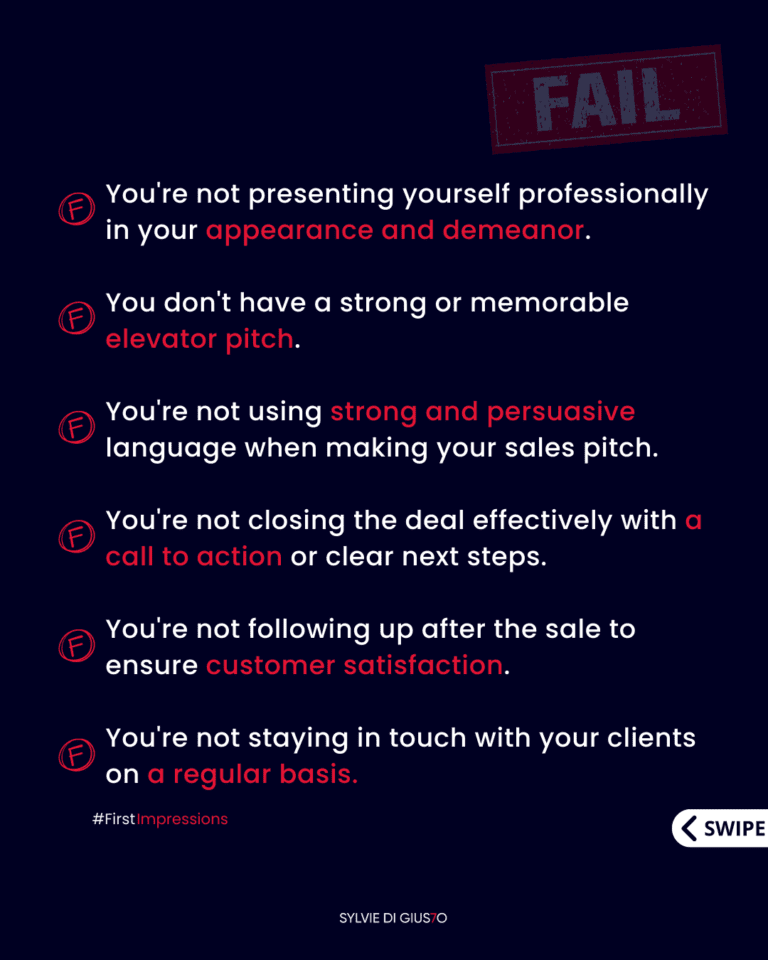
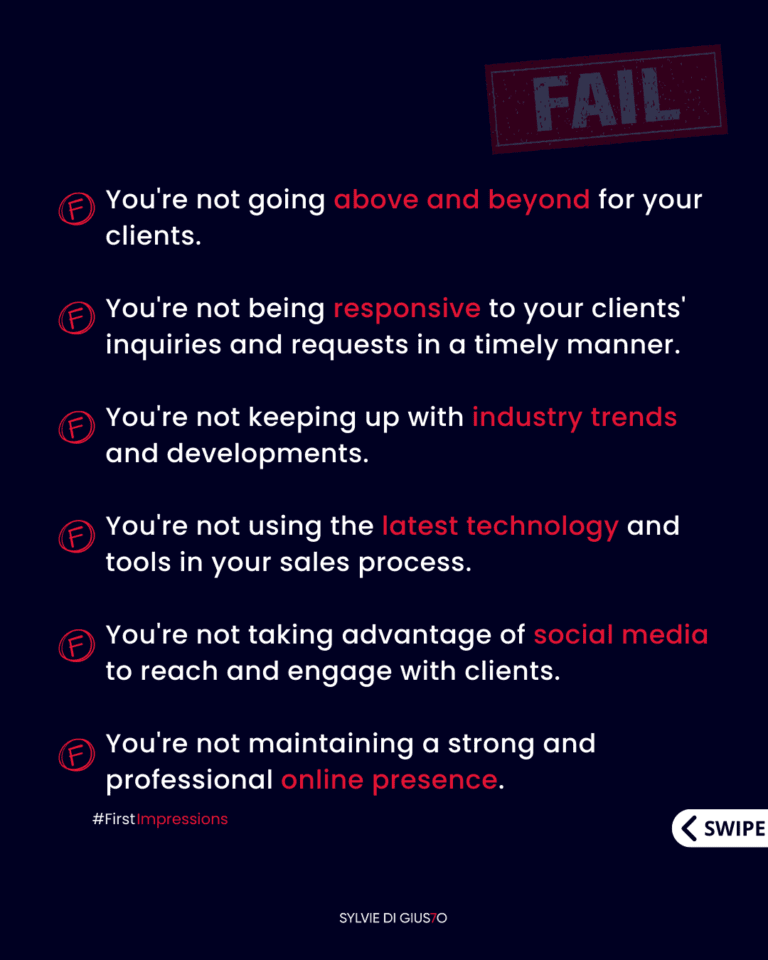
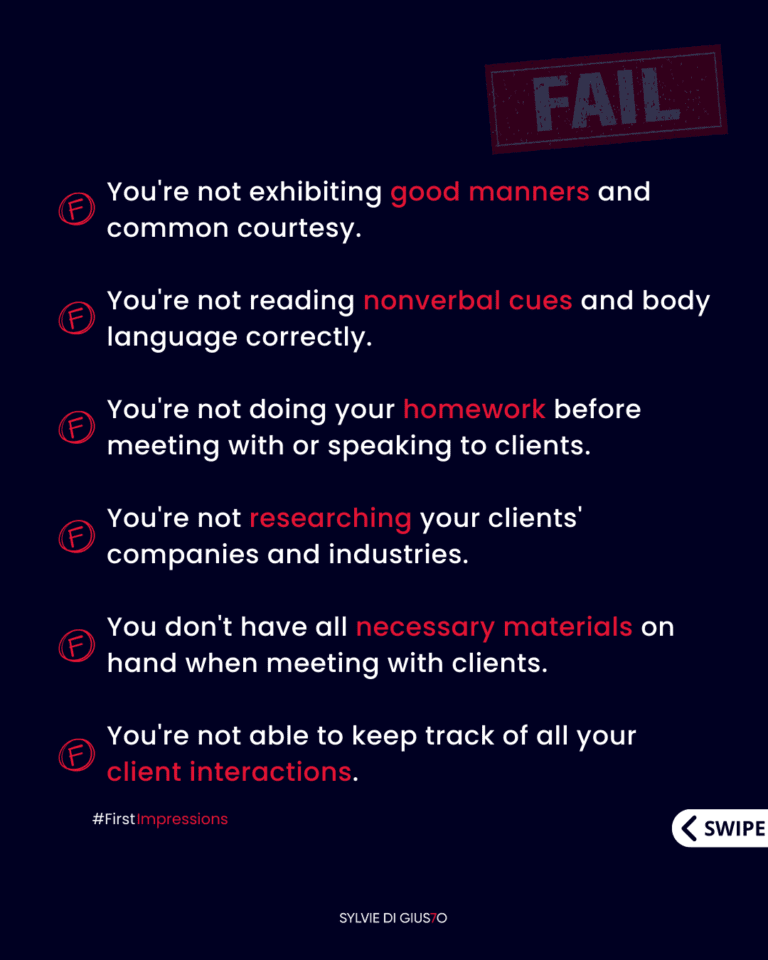
Most common sales mistakes in a nutshell



The Image of Leadership: Sales Edition
Most of these mistakes are signals clients read before they ever compare prices. The Sales special edition of The Image of Leadership shows sellers how appearance, behavior, communication, digital presence and environment decide whether they get chosen.
Frequently asked questions
What are the most common sales mistakes?
Among the most common: not listening, not understanding the client’s needs, overpromising, hiding fees, showing little genuine interest, asking no probing questions, arriving late or unprepared, sounding arrogant, lacking enthusiasm, using the same pitch for everyone, mishandling objections and failing to explain what makes your product different.
Why do salespeople lose deals they should win?
Usually because of trust, not product. Clients sense when a salesperson is not listening, is hiding costs or cares more about the commission than their needs. Those signals form early, often in the first impression, and clients rarely explain why they chose someone else.
How do I come across as confident but not arrogant in sales?
Listen more than you talk, watch your body language, never sound condescending, focus on the value you add rather than on yourself, and balance confidence with humility. Being approachable, empathetic and willing to learn keeps confidence from tipping into arrogance.
Should salespeople be upfront about fees and commissions?
Yes. Transparent pricing, clear payment terms and honesty about how you are paid build trust. Hidden charges or surprises later in the process often kill the deal and the relationship. Transparency signals that you have nothing to hide and the client’s interests at heart.